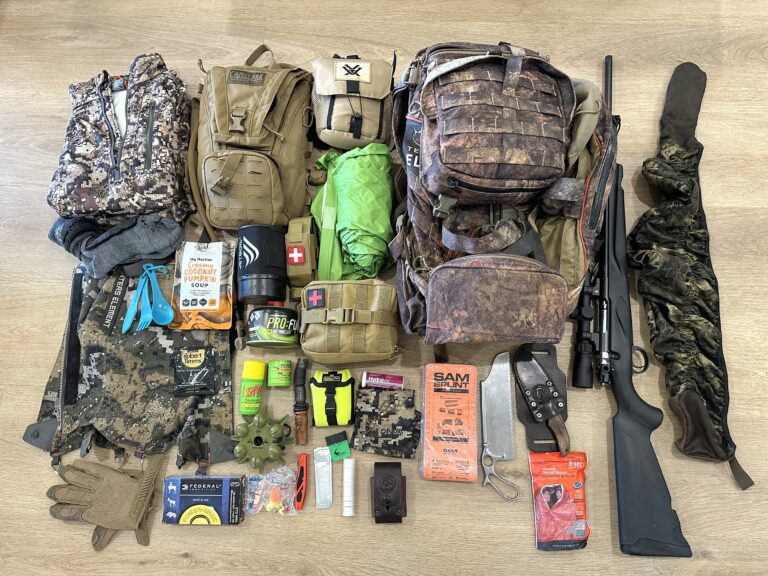
There are three types of people; those who think they’ll never get hurt, those who think they’ll power through an injury, and those who prepare for the worst case scenario.
This guide was written for the latter. It outlines universally recognised methods to signal for help, and explains when and how to use them.
Mobile Phone
By far, the most obvious choice to signal for help will be your mobile phone. This should be your primary method to contact emergency services. However, its important to understand that your call may not always be successful. This can occur for two reasons:
- The network is under heavy strain, like in the event of a significant natural disaster, or;
- Your phone cannot connect to a cell phone tower, which is often the case when hunting in remote areas.
Contrary to popular belief, you don’t need phone credit or a SIM card to make an emergency call. However, you do require mobile phone reception. If your provider (e.g., Telstra) has no service, your phone will try to “camp-on” (or “piggy-back”) to another available network to make the call. If there is no network coverage in the area, your call will fail.
By now, you’re probably wondering if you should bother to make the call when your phone displays ’emergency calls only’ or ‘no signal’? The answer is yes. If you need help, its important to still make the call – even if your phone displays Emergency Calls Only or No Signal. This is because your phone will only display the network coverage for your service provider, and not the other available networks in your area.
Location Services
If you have reception, Advanced Mobile Location (AML) technology will automatically send your coordinates to emergency services. This will help them to locate you, even if you don’t know your exact location. However, its important to note that this feature must be enabled on your device, in order for it to work.
Making the call
- Dial Triple Zero (‘000’), or the international standard emergency number (‘112’) on your phone to contact emergency services.
- Give detailed information about your emergency, including; your name, your location, any nearby points of interest (e.g., road names, scenic look outs, or radio towers), the nature of your emergency (e.g., suspected broken leg), and any other information that may be useful, like potential sources of danger.
- Follow the advice given by emergency personnel. In most cases, this will be to stay in your current location and wait for assistance. The only time you should move is when there’s an imminent threat to your safety, like rising floodwaters or a bushfire. If you do move, always attempt to notify emergency services of your new location.
Text messaging
Text messages are a useful secondary form of communication. However, they should not be solely relied upon, as they are equally prone to failure without reception.
Satellite devices and SOS features
Chances are, wherever you’ll be hunting won’t have phone reception. Thankfully, most modern mobile phones have built in satellite SOS “help” features to overcome this obstacle. Once activated, your phone will automatically send out text messages – which includes your current location, to designated, pre-set emergency contacts. This feature will continue to track your location and provide updates to these contacts until disabled in your phone settings.
Certain phone models may also contain the following safety features:
- Discreet Recording and Data – Once activated, the phone will record 5-seconds of audio or video, or in some instances – take photos, and send these to your emergency contacts.
- Medical Information Sharing – This feature will provide your medical information to emergency responders (e.g., allergies, medical conditions, or blood type).
- Car Crash Detection – Sensors inside your phone will detect severe accidents and automatically call for help. This is an important feature if travelling off-road on slippery or uneven terrain.
Alternatively, you may wish to purchase a satellite phone or a GPS device which contains satellite messaging, like a Garmin InReach. While useful, these devices are expensive to purchase and may require ongoing subscription fees. Generally speaking, a newer, more advanced mobile phone will be a far better option for most hunters.
How to use your phone’s satellite SOS features
On iPhones, pressing the side button five times, or holding the side button and a volume button together will trigger this feature. On Androids, between three and five rapid presses of the power button will activate this feature – depending on the model of phone.
Starlink and WiFi
If you own a Starlink device, or similar system, you can use the internet to seek help. The most common apps for this purpose are:
- Emergency+ app – This tool allows you to contact Triple Zero (‘000’), and provide call centre operators with fast and accurate information about your emergency. It also contains the feature called “What3words”. In short, this feature will generate three words that correspond with your current location. With this information, emergency services can pin-point your position to a 3m x 3m square on a map.
- Internet-based calling apps – If mobile reception is down, use the Wi-Fi calling features on your phone to seek help through social media apps, such as; WhatsApp, Skype, or Facebook Messenger.
- Social Media – During large-scale disasters, emergency services will often monitor social media platforms to identify where help is needed. It’s also an effective way to communicate your situation with friends and family.
Personal Locator Beacon (PLB)
A personal locator beacon is a compact device used to transmit a satellite distress signal to search and rescue services. This is particularly useful in remote areas where phone or radio communication is unreliable.
Each device is registered to the user. Once activated, search and rescue services first try to contact the registered owner to verify whether assistance is required, or if an accidental activation has occurred. If contact cannot be made with the registered owner, they will attempt to contact the person listed as the emergency contact. Pending the response from this person, Police, Ambulance, or State Emergency Services (SES) may attend the site and attempt to locate the person near the source of the distress signal.
A personal locator beacon differs from an emergency positioning indicator radio beacon (EPIRB) in that the latter is registered to a vessel (boat), instead of a person. EPIRB’s are a legal requirement when travelling more that 2 nm offshore and are designed to remain buoyant in rough seas.
Unfortunately, not all PLB’s are designed to float.
If I were facing an emergency situation in the bush and had access to a PLB and a mobile phone, I would use both devices to seek assistance.
Activating the signal
- Extend the aerial on your device.
- Slide the plastic cover away from the activation button.
- Press the button to activate.
Note: The activation process may differ between models. Always familiarise yourself with the device before taking it out into the field and test your battery at regular intervals, as outlined in the user manual.
UHF Radio
A UHF radio is a hand-held, or vehicle-mounted device that is used to transmit and receive voice signals over vast distances. This can be a useful asset to gather information, such as weather forecasts or road hazards, and can be used to seek help in an emergency situation. Overall, UHF radios are designed to be rugged and waterproof, and are one of the most reliable communication methods to use in the field. However, they do have some limitations.
Dense forests and large mountains will reduce the effective range. There’s also no guarantee that anyone will be listening to your selected channel when you’re making an emergency broadcast. In non-life threatening situations, such as a vehicle break down, this would be my primary method to seek assistance. This is due to the close proximity of the responder to my location, compared with a phone call to friend or family member who may be hundreds of kilometres away.
With that said, I would not solely rely upon a UHF radio in the event of a medical emergency.
For a complete rundown of this device, check out the UHF radios and the Australian Channel Guide.
Calling for help on a UHF radio
- Select a channel to broadcast on. Emergency channels are 5 and 35. Channel 12 may also be monitored by other users in State Forests and National parks.
- Hold the talk button and say “Emergency, Emergency, Emergency”.
- Release the talk button and wait for a response.
- If someone answers your call, hold the talk button and provide them will detailed information about your emergency, as discussed in the mobile phone section above.
- Release the talk button and wait for further communication.
- Repeat this process as necessary.
Flares / Smoke beacons
Flares and smoke beacons are predominately used in maritime environments. They act as a visual distress signal to alert nearby aircraft, watercraft, or land-based observers of an emergency. Once activated, the device will emit either a large plume of orange smoke or a bright red beacon of light, dependent upon which type of flare is chosen.
When to activate a flare or smoke beacon
As a marine flare will only remain active for a relatively short period of time, thought should always be given to your situation, and the likelihood that your distress signal will be observed, prior to activation. Even in the most ideal weather conditions, there is no guarantee that your flare will be noticed. Best practice is to activate the device once a direct line of sight has been established with an observer, or if the engine is heard from a passing aircraft.
For more information, check out our guide to marine flares.
Other emergency signals
The following distress signals should be considered a last-resort measure to seek help, as they are far less effective than modern technology.
Orange signal flag
An orange signal flag is a light weight, high-visibility distress tool used to signal for help during emergencies. It’s used by waving the bright-coloured surface in the direction of aircraft or observers within your visual line of sight, or by attaching it to your backpack or a tree.
As you’d expect, this tool will be much more effective when used in open areas.
Most flags are durable, waterproof, fold down into a small package, making them a useful asset for weight-conscious hunters who venture into remote areas. Some flags may also contain reflective materials, which further increases their visibility.
“Three signals” – The universal sign of distress
Using three of any signal is the universal sign of distress. Common examples include; 3x long whistle blasts, 3x flashes of a reflective mirror, 3x evenly spaced fires, or 3x evenly spaced gunshots.
If using signal fires, its recommended that you do not ignite them until you sight an aircraft, or hear the noise of the engines. Once alight, adding green boughs (main branches of a tree) will draw attention to your position by creating thick white smoke.
Alternative ground signals
The following two signals can be formed on the ground in an open environment:
- Mark an ‘X’
- Spell out ‘SOS’
As a minimum, the shape of these signals can be created by walking lines in snow, grass, or sand. If possible, the shape should be further emphasised by adding branches and rocks to make this distress signal more obvious.
Remember: The bigger you create this signal, the more effective it will be. The aim is to make it so large, that it becomes impossible to miss by nearby aircraft.
Responding to an emergency signal
If you witness a distress signal, and are willing to maintain contact or render assistance, you should:
- Acknowledge the signal with three signals of your own (e.g., whistle blasts),
- Mark the person’s location on a map, or take note of their approximate position by cross-referencing it with obvious geographical land marks, then;
- Immediately contact emergency services and pass on this information.
Do not overlook the value of responding to a call for help with your own signals, as this will provide the victim with reassurance and hope of a successful rescue.
Summary
By now, you’re probably contemplating which option(s) you should carry on your next outing, and like most things, there is no universal “best” solution – only what works for your individual circumstances.
My recommendation is to choose something that falls inside your budget, and that you are prepared to carry in the field, or have stowed inside your boat. For most of us, that will be a mobile phone with an emergency app installed, and a UHF radio. Others may also wish to add a PLB to their kit, like I did, and that’s ok too.
No matter what you carry, always familiarise yourself with its use before heading into the field, and try to have at least one alternative method of communication to act as a redundancy – in case your primary method fails.
Before committing to a product, also consider the time and ongoing maintenance that it may require – like the ongoing cost of a satellite GPS messaging service, or the inspection requirements of a PLB or marine flares.
Finally, if you’re caught in an emergency situation – don’t be afraid to activate your lifeline and seek help. On face value, that may seem like a stupid thing to say given the context, but I speak from experience in that I’ve downplayed a few medical issues during my trips away, which in hindsight, could’ve ended badly.
In most cases it was pride that stopped me seeking assistance. In one particular case, I was just blissfully unaware of the consequences (of cellulitis). Nevertheless, it was just dumb luck that I was able to push through and seek treatment later.
You may not be so lucky.