
Introduction
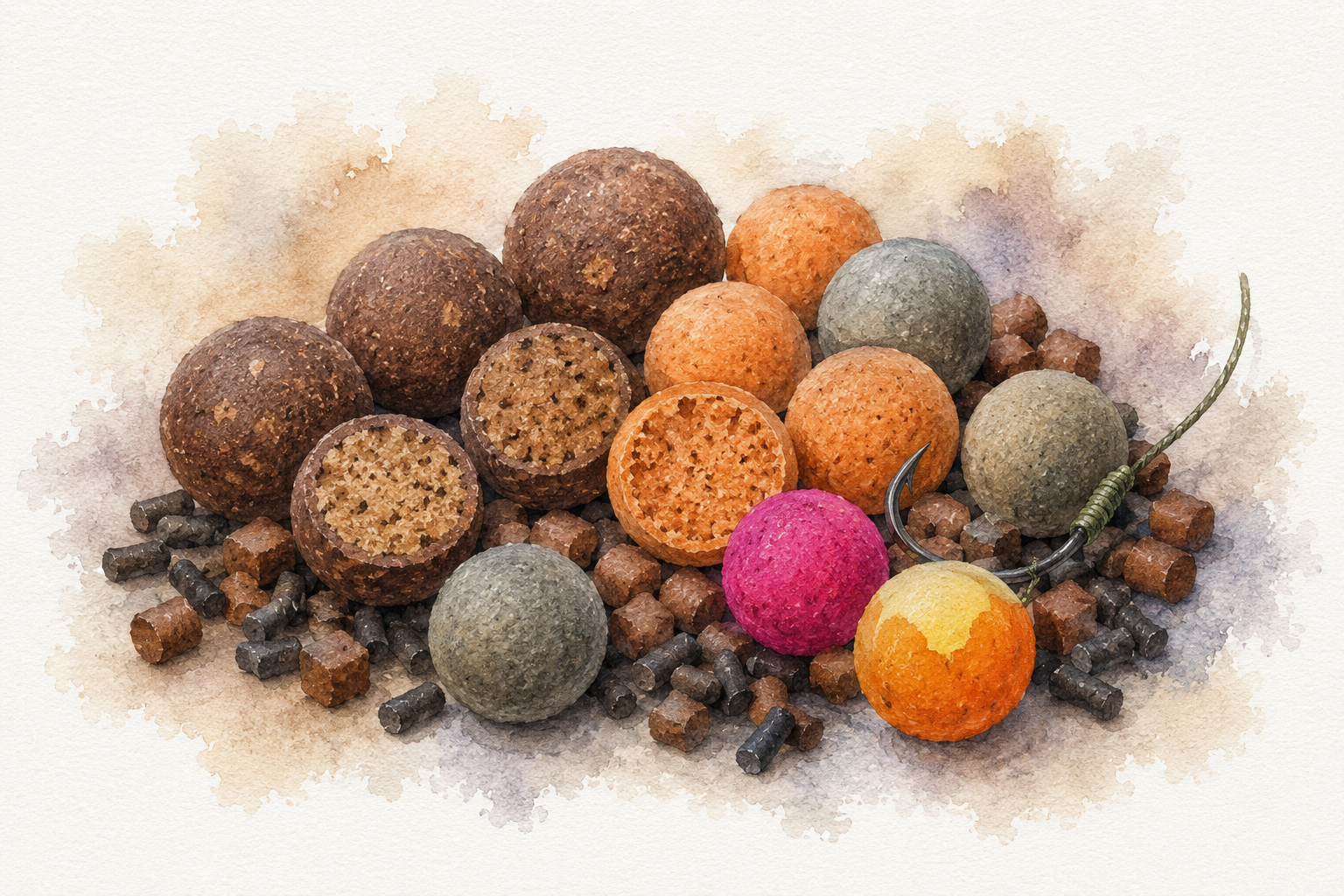
Boilies are manufactured fishing baits made by combining dry ingredients with eggs or another binding agent, rolling the mixture into balls and cooking them to produce a firm, durable bait.
Developed for specialist carp fishing, boilies are particularly suited to targeting European carp (Cyprinus carpio). They withstand casting and can remain intact during extended periods in the water, making them useful when anglers want a bait that doesn’t require frequent replacement.
Most boilies are approximately 10–20 mm in diameter, although their size, texture, colour and composition vary considerably. Homemade versions can be adjusted to suit individual preferences, while commercial products are available in numerous formulations.
Boilies are commonly used in three presentations:
- Sinking boilies: Rest on the bottom.
- Pop-ups: Float above the bottom when correctly rigged and counterweighted.
- Wafters: Have enough buoyancy to partially or substantially counterbalance the weight of the hook.
In Australia, boilies are a specialist alternative to familiar carp baits such as corn, bread and dough. Their main advantages are durability, consistent sizing and the ability to control how the bait sits in the water.
Sourcing the Bait
Boilies can be purchased from specialist carp-fishing retailers, selected tackle shops and online suppliers. They can also be made at home from ingredients available through supermarkets and food retailers.
Commercial boilies differ in both their presentation characteristics and storage requirements.
Shelf-life boilies are formulated and packaged for storage without freezing, subject to the manufacturer’s instructions. Freezer boilies generally require frozen storage because they are fresh or contain fewer preservatives.
Separately, boilies may be sold as sinking baits, pop-ups or wafters. These terms describe buoyancy and presentation rather than shelf life.
For anglers new to boilies, a conventional sinking variety is a practical starting point. Specialist buoyant hookbaits become useful when a bottom presentation needs adjustment.
Homemade boilies are particularly worthwhile for anglers who want to experiment with ingredients, control bait firmness or prepare larger quantities without relying on specialist products.
Recognising Quality
A conventional sinking boilie should be firm enough to survive handling, mounting and casting without splitting. It should also remain intact for a reasonable period after immersion.
Not all boilies are intended to be equally hard. Some are deliberately softer or designed to release soluble ingredients more quickly.
For commercial products, check for unexpected mould, excessive moisture or other signs of deterioration. Colour alone is not a reliable indicator of quality.
For homemade boilies, consistency is more useful than appearance. Unevenly mixed dough can produce baits that vary in texture or crack during cooking.
A practical way to assess a new batch is to place a sample in water and observe how it behaves. Check whether it remains intact, softens gradually or breaks apart. A bait intended for several hours of fishing should retain sufficient structure for that purpose.
Storage and Care
Store commercial boilies according to the manufacturer’s instructions. Keep shelf-life products sealed and protected from excessive heat and moisture. Freezer boilies should remain frozen until needed.
Homemade egg-based boilies require more care. Boiling and air-drying do not automatically make them shelf-stable.
After cooking, spread the boilies on a clean rack or tray and allow them to cool and surface-dry before packaging. Refrigerate them promptly for short-term use or freeze them for longer storage.
Dividing a homemade batch into smaller freezer bags allows anglers to thaw only what they need.
Avoid sealing warm, damp boilies in airtight packaging. Trapped moisture can encourage deterioration.
If a batch develops unexpected mould or signs of spoilage, discard it rather than attempting to restore it through further drying.
Preparing the Bait
Commercial boilies generally require little preparation. They can be used whole, halved or chopped, depending on the intended presentation. Crushed boilies can also be used as loose feed.
Making boilies at home is straightforward and requires only basic kitchen equipment.
Homemade Boilie Recipe
This is a basic sinking-boilie formulation intended as a starting point for home preparation. The proportions use common boilie-making ingredients and methods, although this particular recipe has not been physically tested by Oz Fish & Game.
Ingredients
- 200 g semolina
- 150 g soy flour
- 100 g fine maize meal or polenta
- 50 g skim milk powder
- 4 large eggs, with a fifth available if needed
- Optional: a small quantity of food-grade flavouring
Equipment
- Two mixing bowls
- Kitchen scales
- Saucepan
- Slotted spoon
- Clean tray or drying rack
- Knife and chopping board
Step 1 — Mix the Dry Ingredients
Combine the semolina, soy flour, maize meal and milk powder in a large bowl. Mix thoroughly to distribute the ingredients and break up any lumps.
Step 2 — Prepare the Eggs
Crack four eggs into a separate bowl and beat until combined.
If using a flavouring, mix a small quantity into the eggs. Vanilla is one accessible option, although additional flavouring is not essential.
Step 3 — Form the Dough
Gradually add the dry mixture to the beaten eggs, mixing as the dough forms.
Continue until the mixture becomes firm, smooth and pliable. It should hold together when rolled without sticking excessively to your hands.
If the dough remains wet, incorporate more dry mixture. If it is too dry or crumbly, add a little more beaten egg, using the fifth egg if required.
Do not force all the dry ingredients into the mixture if the correct consistency has already been reached. Egg size and ingredient absorbency will affect how much is needed.
Knead until the dough is reasonably uniform.
Step 4 — Roll the Boilies
Divide the dough into manageable portions and roll each into a long sausage.
Cut into short sections and roll each piece between your palms to form a ball.
For a first batch, approximately 12–16 mm diameter is a useful starting size.
The balls do not need to be perfectly round, although consistent sizing helps them cook evenly.
Step 5 — Boil the Bait
Bring a saucepan of water to a steady boil.
Add the boilies in small batches, leaving enough space for the water to circulate.
Once the water returns to a boil, cook 12–16 mm boilies for approximately 1½–2 minutes as a starting point.
Adjust the cooking time according to bait size and the desired firmness. The ingredients and subsequent drying period will also affect the finished texture.
Remove the boilies using a slotted spoon and drain them.
For unfamiliar recipes, cook a small test batch first and check the finished texture before processing the remainder.
Step 6 — Dry and Store
Spread the cooked boilies in a single layer on a clean tray or drying rack.
Allow them to cool and air-dry until the surface is no longer wet or tacky. Longer drying can produce a firmer bait, although the result depends on the recipe.
Once cooled and sufficiently surface-dried, refrigerate or freeze the boilies.
Do not assume homemade boilies are suitable for unrefrigerated long-term storage simply because they have been boiled.
Adjusting the Recipe
Once the basic mixture produces a satisfactory boilie, the proportions can be modified to change its texture and behaviour.
Coarser ingredients may produce a more textured bait, while finer ingredients generally make a smoother dough. Changes to the egg content, base mixture, cooking time and drying period can all affect firmness.
Flavourings can also be varied, but strongly scented bait is not necessarily more effective.
For beginners, producing a consistent boilie that remains intact during casting and immersion is more important than using an elaborate mixture of additives.
How to Rig It
Understanding a Hair Rig
A hair rig is a fishing rig that holds the bait separately from the hook.
With conventional bait fishing, anglers often push the hook directly through the bait. A hair rig works differently: the boilie sits on a short extension of line called the hair, positioned beside or just beyond the hook.
On a conventional knotless-knot hair rig, this hair is formed from the hooklink — the length of line connecting the hook to the rest of the rig — and is secured along the hook shank.
The boilie is threaded onto the hair using a baiting needle, then secured with a small bait stop. The stop passes through a loop at the end of the hair and prevents the boilie from sliding off.
This arrangement leaves the hook point unobstructed.
When a carp takes the boilie into its mouth, the exposed hook can follow. As the fish moves or attempts to eject the bait, a correctly arranged rig allows the hook point to turn and potentially take hold.
Hair rigs are especially useful for boilies because firm baits can be difficult to mount directly on a hook without affecting its operation.
How to Attach a Boilie
A ready-tied hair rig is a practical option for beginners.
- Check the hair length. It must accommodate the chosen boilie while allowing the hook to remain clear.
- Thread the boilie. Push a baiting needle through the centre of the boilie.
- Pull through the hair. Catch the loop at the end of the hair with the needle and draw it through the bait.
- Insert the bait stop. Pass a small stop through the hair loop.
- Secure the boilie. Gently pull the bait against the stop and check that it cannot slide off.
- Check the hook. The boilie should sit separately from the hook, leaving the point exposed.
Sinking Boilies
Sinking boilies are usually presented on or close to the bottom.
They are straightforward to use over firm, relatively clear lakebeds. Soft silt, heavy weed or debris may make a conventional bottom presentation less effective if the bait becomes obscured.
Pop-Ups
Pop-ups are buoyant boilies designed to lift the hookbait above the bottom.
They require a rig designed or adjusted for buoyant bait. A conventional sinking-boilie hair rig should not automatically be assumed to provide the correct presentation.
Counterweight, hook weight and rig design determine how high the bait sits.
Test the completed rig in shallow water to confirm its position before casting.
Wafters
Wafters are balanced or semi-buoyant hookbaits intended to reduce the effective weight of the presentation.
Depending on the hook and bait combination, a wafter may settle gently onto the bottom rather than sitting heavily against it.
As with pop-ups, test the completed rig because the resulting buoyancy depends on the whole arrangement.
Using Boilies as Loose Feed or Berley
Boilies can be used without attaching them to hooks.
The boilie mounted on the hair rig is the hookbait. Additional boilies introduced into the surrounding water are loose feed, also commonly described as berley or groundbait.
Whole boilies can be scattered around the fishing area, while chopped or crushed boilies provide smaller food particles.
The purpose is to encourage carp to forage near the hookbait.
The quantity should reflect fish activity, water temperature, the number of fish present and the duration of the session.
Large-scale feeding can be effective in some circumstances, but adding substantial quantities when carp are feeding slowly may be counterproductive.
Check local bait and berley restrictions before fishing, particularly in designated artificial lure or fly-fishing waters where manufactured baits may be prohibited.
Best Fish to Target
European Carp
European carp (Cyprinus carpio) are the principal established target for boilies in Australian recreational fishing.
Carp are opportunistic omnivores that forage for aquatic invertebrates, plant material and other food sources. Their feeding behaviour makes them well suited to bottom-presented manufactured baits.
Boilies are useful when anglers want to leave a bait in position for an extended period or control its size and buoyancy.
In lakes and impoundments, carp may forage along shallow margins, weed edges and submerged features. In rivers, sheltered margins, backwaters and slower-flowing sections can provide suitable fishing areas.
A sinking boilie on a hair rig is a practical starting point. Where bottom conditions make this presentation unsuitable, a wafter or pop-up may be more effective.
Carp feeding activity changes with water temperature and other environmental conditions. Cooler water often reduces feeding activity, but carp can still feed and be caught during winter.
Boilies are not necessarily more effective than corn, bread or dough in every Australian fishery. Their principal advantage is the control they provide over bait durability and presentation.
Common Mistakes
Using a boilie that breaks apart too easily
A bait that splits during casting or disintegrates shortly after immersion may not remain available to feeding fish. Check its firmness before fishing.
Making homemade dough too wet or dry
Sticky dough can be difficult to roll, while crumbly dough may crack during cooking. Adjust the wet and dry ingredients gradually until the mixture is workable.
Assuming boiling time alone determines firmness
Ingredient composition, cooking and drying all influence the finished texture. Test small batches when experimenting with a new recipe.
Using an unsuitable buoyancy or rig
A sinking boilie may disappear into soft silt, while a poorly balanced pop-up may sit higher than intended. Match the presentation to the bottom conditions and test the rig.
Obstructing the hook point
A poorly positioned boilie or unsuitable hair length can interfere with hooking. Check that the bait is secure and the hook point remains exposed.
Introducing excessive loose feed
Carp feeding activity varies with water temperature, seasonal conditions and available food. Introducing large quantities of boilies when fish are feeding slowly may reduce the likelihood of them taking the hookbait.
Start with modest quantities and adjust according to observed fish activity and the length of the session. Heavier feeding can be useful when carp are actively feeding or when deliberately establishing a feeding area.
Storing homemade boilies incorrectly
Homemade egg-based boilies can deteriorate if left warm or damp. Cool and surface-dry them before packaging, then refrigerate or freeze them.
The Bottom Line
Boilies are durable manufactured baits designed primarily for European carp fishing. They offer anglers control over bait size, texture and buoyancy, while remaining suitable for extended presentations.
Commercial boilies are convenient, but homemade versions can be produced using ordinary ingredients and basic kitchen equipment.
A simple sinking boilie on a correctly prepared hair rig is a useful starting point. Pop-ups and wafters offer additional options where bottom conditions require a different presentation.
Boilies can also be introduced separately as loose feed to encourage carp to forage around the hookbait.
They are not essential for catching carp, but their durability and versatility make them a worthwhile option for anglers interested in more specialised carp-fishing methods.