

Introduction
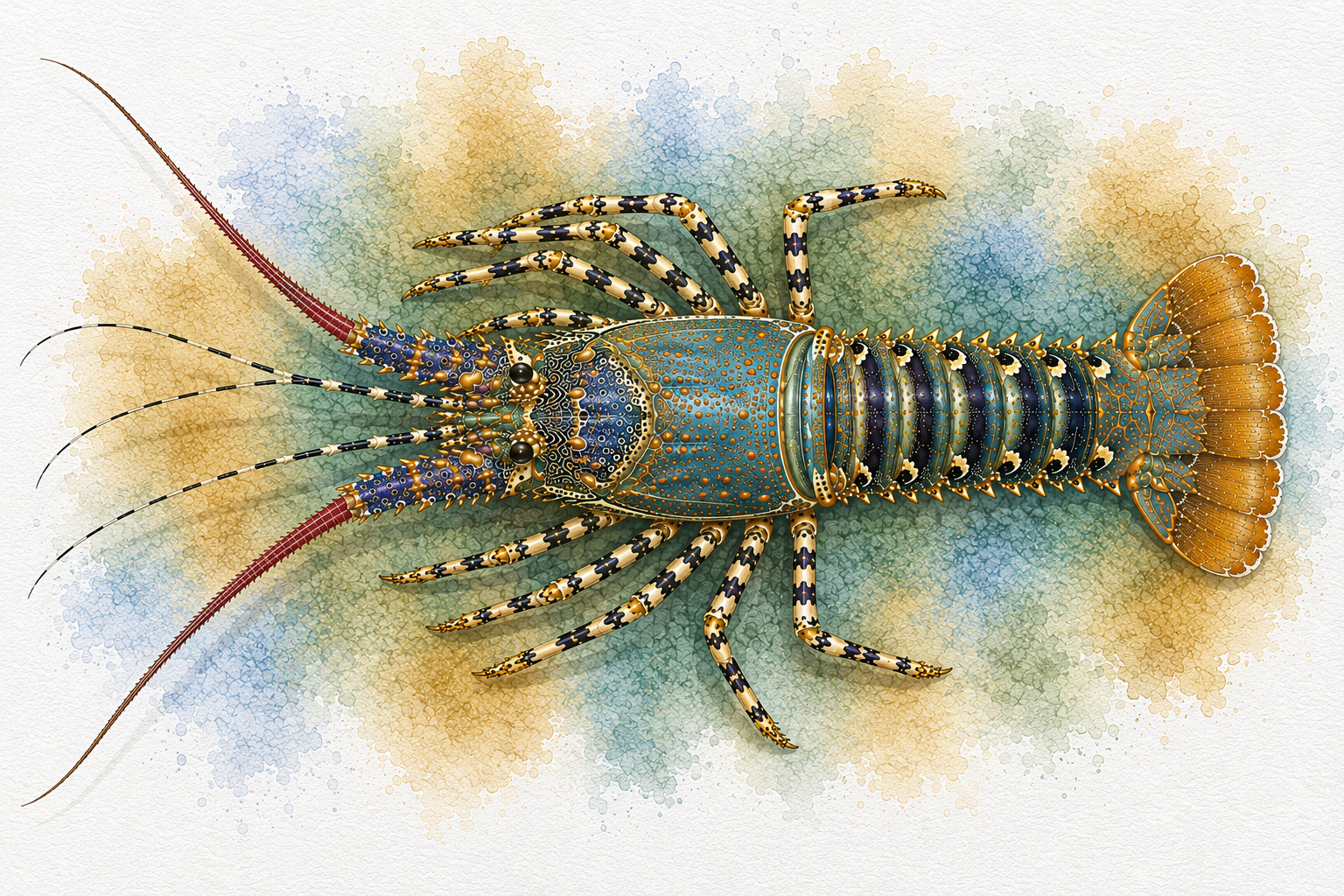
The ornate rock lobster (Panulirus ornatus) is unlike any other lobster encountered by Australian recreational fishers. While southern lobster fisheries revolve around deep reefs, heavy pots and cool temperate water, this tropical species is closely tied to coral reef systems, shallow bommies and warm coastal waters across northern Queensland.
Although famous internationally for its spectacular colours, Australian anglers generally value ornate rock lobsters for one reason—they grow exceptionally large. Adults commonly exceed the size of painted rock lobsters found on the same reefs, with mature animals capable of filling an esky with a single catch.
For recreational fishers, however, finding ornate rock lobsters is often the greatest challenge. They occur across enormous areas of reef habitat but are rarely distributed evenly. One bommie may hold numerous legal lobsters while an apparently identical reef nearby holds none at all.
Success comes from understanding where adults establish shelter, how they move throughout the day and season, and learning to recognise productive reef systems rather than simply searching random coral.
Tackle and Rigs
Unlike many recreational fishing guides, success with ornate rock lobster relies very little on specialised tackle. Instead, most captures involve diving, hand collection or recreational lobster pots where regulations permit.
For divers, the essential equipment includes:
- Well-fitting mask and snorkel
- Quality fins suited to repeated reef diving
- Protective gloves
- Catch bag or lobster loop
- Measuring gauge
- Dive torch for inspecting crevices
Many experienced northern divers also carry a short tickle stick or fibreglass rod. Rather than forcing the lobster from its shelter, the stick is used to gently encourage it forward while the opposite hand controls its escape route.
Attempting to grab an ornate lobster by the antennae almost always fails. Their antennae are extremely powerful and designed to brace against reef structure. Instead, wait until the lobster clears the entrance before securing the carapace firmly behind the horns.
When lobster pots are permitted, heavy tropical currents often require considerably more weight than southern fisheries. Pots should sit firmly on the bottom without shifting, particularly around reef edges where tidal flow accelerates.
Because coral quickly abrades ropes, floats and bridles, inspecting gear regularly is essential.
When to Use Baits
Unlike many crustaceans that readily enter baited traps in estuaries, ornate rock lobsters are often influenced just as much by pot placement as bait selection.
Fresh, oily fish generally produce the best results.
Effective options include:
- Fish frames
- Tuna heads
- Mackerel
- Trevally frames
- Reef fish frames
- Fresh mullet
Fresh bait consistently outperforms stale or decomposed bait in tropical water, where bacterial breakdown occurs rapidly.
Positioning pots adjacent to established travel corridors usually produces better catches than simply placing them on open reef. Productive locations include reef gutters, sand channels cutting through coral, isolated coral heads and reef edges where lobsters emerge to forage after dark.
Replacing bait regularly also improves catch rates, particularly during periods of warm water when bait deteriorates quickly.
When to Use Lures
Lures have virtually no role in targeting ornate rock lobsters.
Unlike octopus or squid, rock lobsters are not actively attracted to artificial presentations, and recreational capture relies almost entirely on diving, hand collection or baited pots.
The only practical “artificial” equipment influencing success is the use of dive lights during low-light conditions. A quality torch allows divers to inspect deep cavities beneath coral ledges where large adults often remain hidden throughout daylight hours.
Time of Day
Time of day significantly influences both lobster behaviour and diver success.
During daylight, ornate rock lobsters usually remain deep beneath coral bommies, caves and reef ledges where they are protected from predators. Larger adults often occupy surprisingly small entrances leading into extensive cavities beneath the reef.
Finding these shelters requires patience rather than covering large distances.
Many experienced divers spend considerably longer inspecting individual bommies than swimming between them.
Late afternoon and dusk often provide increased activity as lobsters begin positioning closer to cave entrances before emerging after dark.
Night diving generally offers the highest encounter rates because lobsters actively leave shelter to forage across reef flats and adjacent sand.
They are often found surprisingly far from their daytime refuge.
However, night diving around coral reefs introduces additional safety considerations, including navigation, boat traffic and marine hazards. Recreational divers should only undertake night dives when properly equipped and experienced.
Common Mistakes
One of the most common mistakes is concentrating only on obvious caves.
Large ornate rock lobsters frequently occupy complex internal reef cavities that are invisible from above. Small openings beneath coral overhangs may lead to extensive chambers holding multiple adults.
Another mistake is searching only the shallow reef crest.
While juveniles often inhabit shallower coral habitats, larger adults frequently occupy deeper reef slopes, rubble fields and outer reef margins where shelter is more substantial.
Many beginners also move too quickly between bommies.
Experienced lobster divers often inspect every shadow, crack and undercut before moving on. A single productive bommie can justify twenty minutes of careful searching.
Poor approach technique also costs many captures.
Swimming directly toward a lobster encourages it to retreat deeper into the reef. Approaching slowly from the side while anticipating its escape direction greatly improves capture success.
Finally, many recreational fishers underestimate tidal current.
Strong current not only makes diving more difficult but also limits the ability to thoroughly inspect reef structure. Planning dives around slack water frequently produces better results while greatly improving safety.
The Bottom Line
The ornate rock lobster is one of Australia’s most impressive tropical crustaceans and offers a very different experience from southern rock lobster fisheries. Rather than deep temperate reefs, success depends on learning coral reef structure, recognising productive shelter and understanding how lobsters use the reef throughout the day.
Divers who slow down, carefully inspect every likely cavity and return to productive reef systems over successive seasons consistently outperform those who simply cover ground. The biggest ornate rock lobsters are seldom found by chance—they are usually taken by fishers who understand that subtle reef features, tidal timing and patient observation matter far more than distance travelled.
For northern Australian recreational fishers prepared to invest the time, few reef harvests are more rewarding than lifting a large, brilliantly coloured ornate rock lobster from beneath a coral ledge after finally spotting the unmistakable banded antennae protruding from the darkness.