
Introduction
Southern calamari are one of Australia’s most popular and rewarding inshore cephalopods. Found throughout the cooler coastal waters of southern Australia, they are prized for their exceptional eating quality, exciting visual fishing and accessibility from boats, jetties, breakwalls and even shallow beaches.
Unlike many traditional fish species, southern calamari are almost always targeted with specialised squid jigs rather than bait. Watching a squid materialise from a patch of ribbon weed before grabbing a slowly sinking jig is one of recreational fishing’s great experiences. They can be caught throughout the year, but spring and autumn generally provide the most consistent action as large adults move into shallow coastal waters to spawn.
For anglers willing to learn how squid use habitat, tides and light levels, southern calamari are a reliable and highly enjoyable target.
Identification
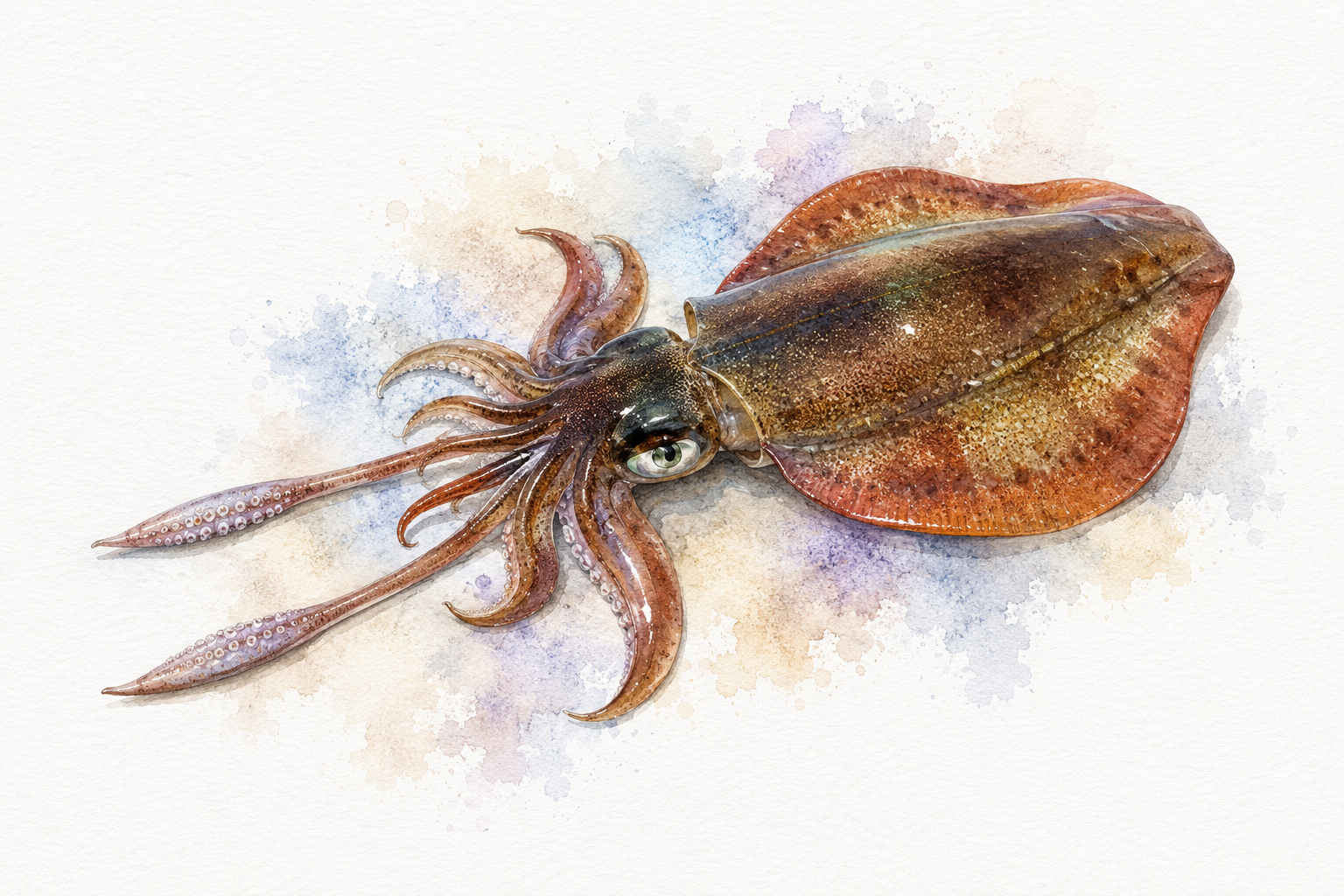
Southern calamari are among Australia’s largest inshore squid and are easily recognised by their broad, oval fins that extend almost the full length of the mantle, giving them a shape that resembles a cuttlefish more than a typical arrow squid.
Their colour changes constantly. Depending on mood, surroundings and behaviour, they may appear translucent silver, olive-green, bronze, brown or almost white. Rapid flashes of colour ripple across the body as specialised pigment cells respond to changing light, camouflage needs and communication with other squid.
Large eyes provide excellent vision, while ten appendages surround the mouth—eight shorter arms lined with suckers and two longer feeding tentacles used to seize prey. The body ends in a pointed mantle with soft fins that allow precise hovering and slow manoeuvring around weed beds.
Southern calamari are sometimes confused with arrow squid (Nototodarus spp.), but arrow squid have much shorter fins concentrated towards the rear of the mantle and are generally encountered offshore rather than around shallow seagrass habitat.
Habitat
Understanding habitat is the single biggest factor in consistently catching southern calamari.
Their preferred environment is healthy seagrass, particularly extensive beds of Posidonia and Amphibolis. These underwater meadows support prawns, juvenile fish and crustaceans while also providing ideal spawning habitat where females attach egg capsules to seagrass leaves.
The edges of weed beds are especially productive. Squid commonly patrol the boundary where sand meets vegetation, waiting to ambush baitfish crossing open ground. Rather than casting randomly across an entire bay, experienced anglers focus on these transition zones.
Broken reef, shallow bommies and patches of ribbon weed scattered across sand flats are equally productive. Artificial structure also attracts calamari, with jetties, marina pontoons, breakwalls, moored boats and navigation markers often holding squid when baitfish congregate nearby.
Water clarity is critical. Southern calamari are highly visual predators and generally hunt most effectively in clean, clear water. Heavy swell, flood runoff or prolonged strong winds that reduce visibility often make fishing significantly more difficult.
Although commonly found in less than five metres of water, calamari also occupy deeper reef systems down to around 30 metres where suitable weed and structure occur.
Collection Equipment
Unlike many seafood species, southern calamari require very little specialised equipment beyond a suitable squid outfit and quality jigs.
A light spinning rod between 7 and 8 feet matched to a 1000–2500 size reel provides excellent casting distance while cushioning the squid’s soft tissue during the fight. Braided line around 6–10 lb with a fluorocarbon leader of 8–12 lb offers sensitivity without compromising presentation.
Landing nets are useful when targeting larger squid from elevated jetties or boats, as lifting heavy calamari directly by the jig often results in pulled hooks.
Polarised sunglasses greatly improve visibility over shallow weed beds, allowing anglers to sight-follow squid as they inspect or attack a jig.
A quality squid spike or iki jime tool, along with an ice slurry, helps preserve eating quality immediately after capture.
Squid Jigs
Specialised squid jigs are responsible for the overwhelming majority of recreational southern calamari captures.
Modern cloth-covered jigs imitate prawns or small baitfish and carry two crowns of fine barbless spikes instead of conventional hooks. These spikes grip the squid’s tentacles without tearing flesh unnecessarily.
Jig size should generally match prevailing bait size and water depth. Smaller sizes around 2.5 are ideal for shallow water or cautious squid, while 3.0 to 3.5 jigs are versatile all-round choices for most Australian conditions. Larger jigs are useful in deeper water or when specifically targeting trophy-sized calamari.
Colour selection often matters less than presentation, but natural baitfish colours consistently perform in bright, clear water. Pink, orange and luminous patterns frequently excel under overcast skies, low light or slightly discoloured conditions.
Retrieval Techniques
Southern calamari rarely respond well to fast, aggressive retrieves.
Instead, cast beyond likely habitat and allow the jig to sink close to the bottom or just above the weed canopy. Lift the rod with one or two deliberate sweeps before allowing the jig to glide back down on a controlled semi-slack line. Most strikes occur during this falling phase.
Often the line simply becomes heavier rather than producing a sharp strike. Once steady pressure is applied, the squid usually responds with powerful jet-propelled bursts before gradually tiring.
Long pauses are often just as important as rod movement. Curious squid frequently follow a jig for several metres before committing when it briefly hangs motionless in the water column.
Best Collection Conditions
Calm weather consistently produces the most reliable squid fishing because clear water allows calamari to locate prey and track jigs from greater distances.
Light winds improve boat control and make it easier to maintain contact with the jig, while gentle tidal flow keeps food moving without making presentations difficult.
The first half of an incoming tide is widely regarded as particularly productive, especially over shallow seagrass beds where clean ocean water pushes across the flats. Tide changes can also trigger bursts of activity.
Periods following several days of stable weather often produce exceptional fishing, whereas heavy swell, dirty water and excessive drifting weed usually reduce success considerably.
Time of Day
Southern calamari can be caught throughout daylight hours, but dawn and late afternoon regularly produce the highest levels of activity.
Low-angle sunlight often encourages baitfish movement across weed beds, which in turn attracts hunting squid.
Night fishing around illuminated jetties, wharves and marina lights can also be extremely productive. Artificial lighting attracts baitfish and prawns, creating concentrated feeding opportunities for calamari within casting distance.
Rather than focusing solely on the clock, successful anglers prioritise favourable tides, clear water and suitable weather.
Common Collection Mistakes
The most common mistake is fishing barren sand instead of productive habitat. Squid almost always relate to weed, broken reef or nearby structure, making location far more important than constantly changing jigs.
Fishing too quickly is another frequent error. Fast retrieves leave little opportunity for squid to inspect and attack the lure. Slowing down and allowing longer sink times usually increases catches immediately.
Many anglers also strike aggressively when they feel weight. Because squid are held by fine barbless spikes rather than penetrating hooks, smooth steady pressure is far more effective than a hard hook-set.
Poor handling can also reduce eating quality. Allowing squid to remain in the sun or on a hot deck quickly softens the flesh. Dispatching them promptly and chilling them immediately preserves their excellent table quality.
Finally, anglers often overlook water clarity. If visibility is poor after heavy rain or prolonged swell, relocating to cleaner water usually produces better results than persisting in unsuitable conditions.
Bait Use Applications
Southern calamari are widely regarded as one of Australia’s premier natural fishing baits.
Fresh strips remain tough on the hook and release scent gradually, making them highly effective for snapper, mulloway, gummy sharks, whiting, flathead, morwong and numerous reef species. Whole small calamari also make outstanding baits for larger predatory fish.
Freshly caught squid consistently outperforms frozen product, although properly cleaned and frozen calamari retain excellent bait quality for future trips. Vacuum sealing or freezing in meal-sized portions helps prevent freezer burn and preserves firmness.
Eating Quality & Preparation
Southern calamari are considered among Australia’s finest seafood, with firm, sweet flesh suited to a wide variety of cooking methods.
Cleaning is straightforward. Remove the head, internal organs, quill and skin before rinsing thoroughly. The tubes can be sliced into rings, scored and opened into steaks, or left whole for stuffing.
Very quick cooking over high heat or slow braising produces the best texture. Overcooking is the primary cause of tough calamari.
Keeping squid chilled immediately after capture and processing them promptly helps maintain their outstanding eating quality.
Conservation, Stewardship & Responsible Harvest
Southern calamari are a productive species, but local spawning aggregations can be vulnerable to concentrated fishing pressure.
Take only what you intend to use, particularly when large numbers of breeding adults gather over shallow seagrass beds. Avoid unnecessary damage to seagrass while anchoring or wading, as these habitats support spawning, juvenile fish and countless other marine species.
If releasing a squid, minimise handling and avoid lifting it by the jig alone where possible.
Fishing regulations can vary between Australian states, territories and waterways. Size limits, bag limits, possession rules, collection limits, gear restrictions, protected areas and access restrictions may apply. Always check with your local fisheries department before fishing, collecting, retaining or relocating any species.
Safety Considerations
Southern calamari are commonly collected from rocky headlands, jetties and small boats where slips, waves and changing weather can present significant hazards.
Wear appropriate non-slip footwear on rocks and jetties, remain aware of swell conditions and avoid fishing exposed platforms during rough seas.
Squid frequently discharge ink when landed. Holding them at arm’s length and pointing the siphon away from yourself reduces the chance of an unwelcome spray.
Exercise care when handling squid jigs, as the multiple fine spikes readily catch clothing, nets and fingers.
The Bottom Line
Southern calamari combine outstanding eating quality with exciting, highly visual fishing that is accessible to anglers of almost any skill level. Success depends far more on finding healthy seagrass, fishing clear water and presenting a squid jig slowly than on constantly changing colours or equipment. Learn to recognise productive weed beds, fish around tide changes during calm conditions and let the jig spend plenty of time sinking. Master those fundamentals and southern calamari will become one of the most reliable and rewarding species in your fishing repertoire.