
Introduction
Squid jigs are specialised fishing lures designed to attract squid through a combination of lifelike appearance, darting movements and controlled sinking.
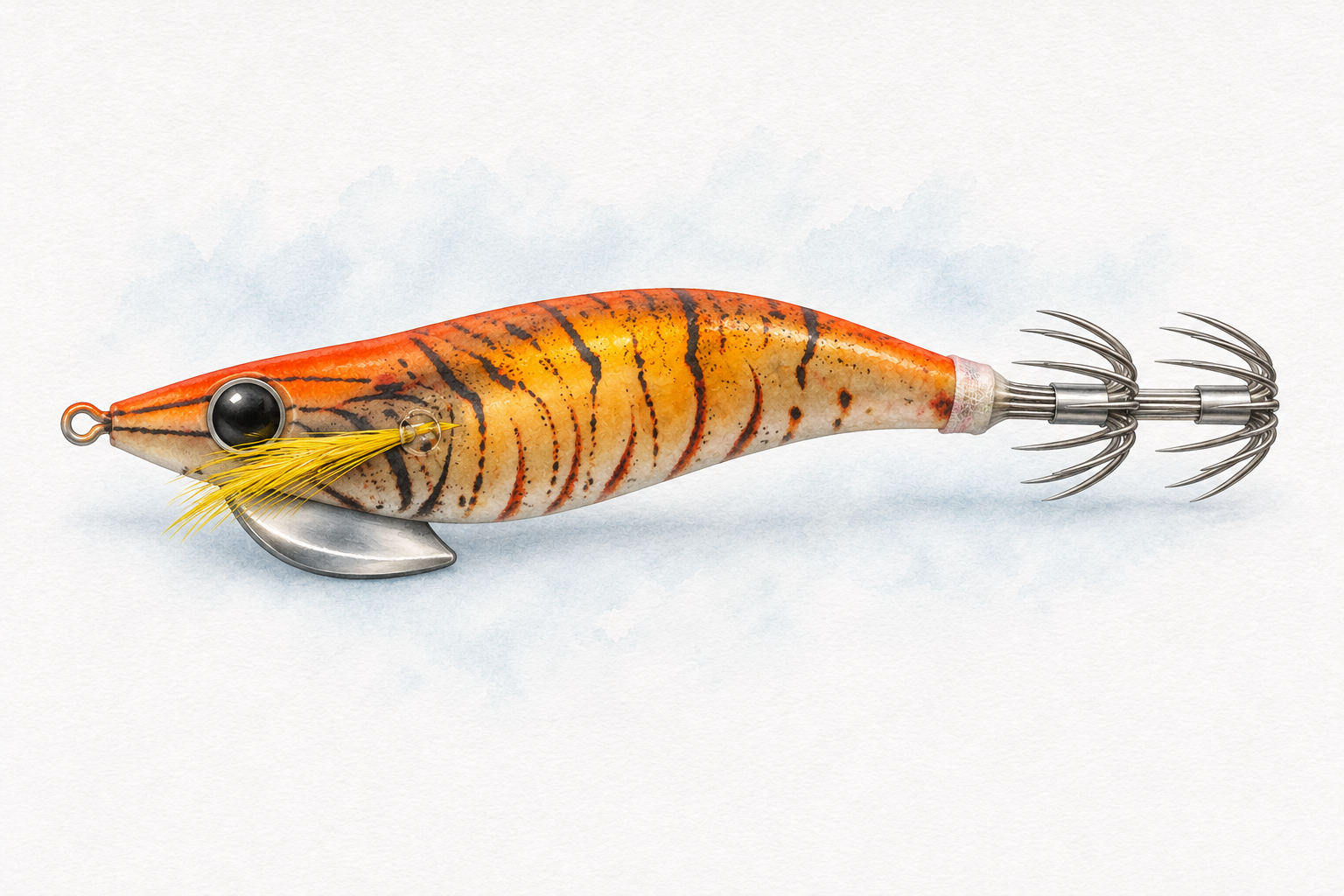
Unlike conventional fishing lures fitted with hooks, squid jigs typically use one or more circular arrangements of fine, backward-facing metal points known as crowns. These catch the squid’s arms and tentacles when it attacks or grabs the lure.
Most squid jigs imitate prawns or shrimp, although their movements and colour patterns can also resemble other small prey.
They are commonly used around seagrass beds, rocky shores, coastal reefs, jetties and other areas where squid hunt.
Successful squid fishing depends on choosing a jig with an appropriate sink rate, working it through the correct depth and maintaining control during the pauses when many strikes occur.
Understanding Squid Jigs
Squid jigs differ from conventional fishing lures in their construction, balance and method of capture.
Most have an elongated body, a weighted underside or nose section, stabilising fins or feathers, and one or more crowns at the rear.
Their design allows them to sink in a controlled attitude and respond to rod movements with short darts, upward lifts or sideways changes in direction.
The action varies between models. Some are designed for aggressive egi-style movements, while others are better suited to slower lifts and controlled descents.
Jig Size
Squid jigs are commonly identified by nominal sizes such as 2.0, 2.5, 3.0, 3.5 and 4.0.
These numbers are size classifications rather than direct measurements of jig weight or length.
Smaller jigs can be useful when squid are feeding on small prey or responding cautiously.
Larger jigs provide a more substantial profile and may offer greater casting distance, depending on their weight and construction.
A larger jig does not automatically sink faster than a smaller one. Sink rate depends on the individual design.
Weight and Balance
Squid jigs are weighted to control their descent and swimming attitude.
Many conventional egi-style jigs sink with their head angled downward and their tail raised, although the precise angle varies between models.
This balance influences how the jig moves during pauses and how it responds to rod movements.
A jig that sinks too quickly for the available water depth may repeatedly contact weed, rock or other structure.
Conversely, a slow-sinking jig may be difficult to keep at the intended depth in strong current.
Sink Rate
Manufacturers often describe squid jig sink rates in seconds per metre.
For example, a jig advertised as sinking at approximately three seconds per metre would theoretically take around nine seconds to descend three metres under the manufacturer’s test conditions.
Actual descent varies with current, line resistance, rigging and the movement of the water.
Sink-rate figures are useful for comparing models, but they should not be treated as exact depth measurements.
Choosing the Right Squid Jig
Size and Profile
Choose jig size according to the squid being targeted, local prey, water depth and fishing conditions.
Smaller profiles can be useful around shallow weed beds or when squid are responding to small prey.
Larger jigs can be effective in deeper water or when a more prominent presentation is required.
Consider casting performance and sink rate alongside body size.
A jig must reach the intended fishing area without descending uncontrollably into surrounding structure.
Sink Rate and Water Depth
Sink rate is one of the most important considerations when selecting a squid jig.
Slow-sinking models are useful for shallow water, working above weed beds and extending the time the jig remains in the strike zone.
Standard-sinking models provide a versatile starting point for general shore-based squid fishing.
Faster-sinking models may be useful in deeper water or stronger current, provided the jig can still be controlled.
The objective is to keep the jig near the depth where squid are holding without continually snagging the bottom.
Colour and Finish
Squid jigs are available in natural, contrasting, fluorescent, reflective and luminous finishes.
Natural prawn-like colours can be useful in clear water, while stronger contrasts may improve visibility in discoloured water or low light.
The underlying body colour and outer cloth or finish can combine to create different appearances as lighting changes.
Colour should be considered alongside depth, action and sink rate rather than treated as the primary factor in jig selection.
UV and Glow Finishes
UV-reactive and glow-in-the-dark finishes perform differently.
UV-reactive materials reflect ultraviolet light when suitable illumination is present. They do not produce their own light.
Glow materials absorb energy from a light source and subsequently emit visible light for a period.
These properties can affect a jig’s visibility under different lighting conditions.
Neither feature guarantees better results. Their usefulness depends on water clarity, available light, depth and squid behaviour.
Crown Configuration
Most squid jigs have one or two rows of rear-facing crown points.
The crowns should be aligned, sharp and free from significant corrosion or deformation.
Different crown designs vary in point spacing, wire thickness and overall strength.
A damaged crown may reduce the likelihood of retaining a squid after contact.
Where to Use Squid Jigs
Seagrass Beds and Shallow Flats
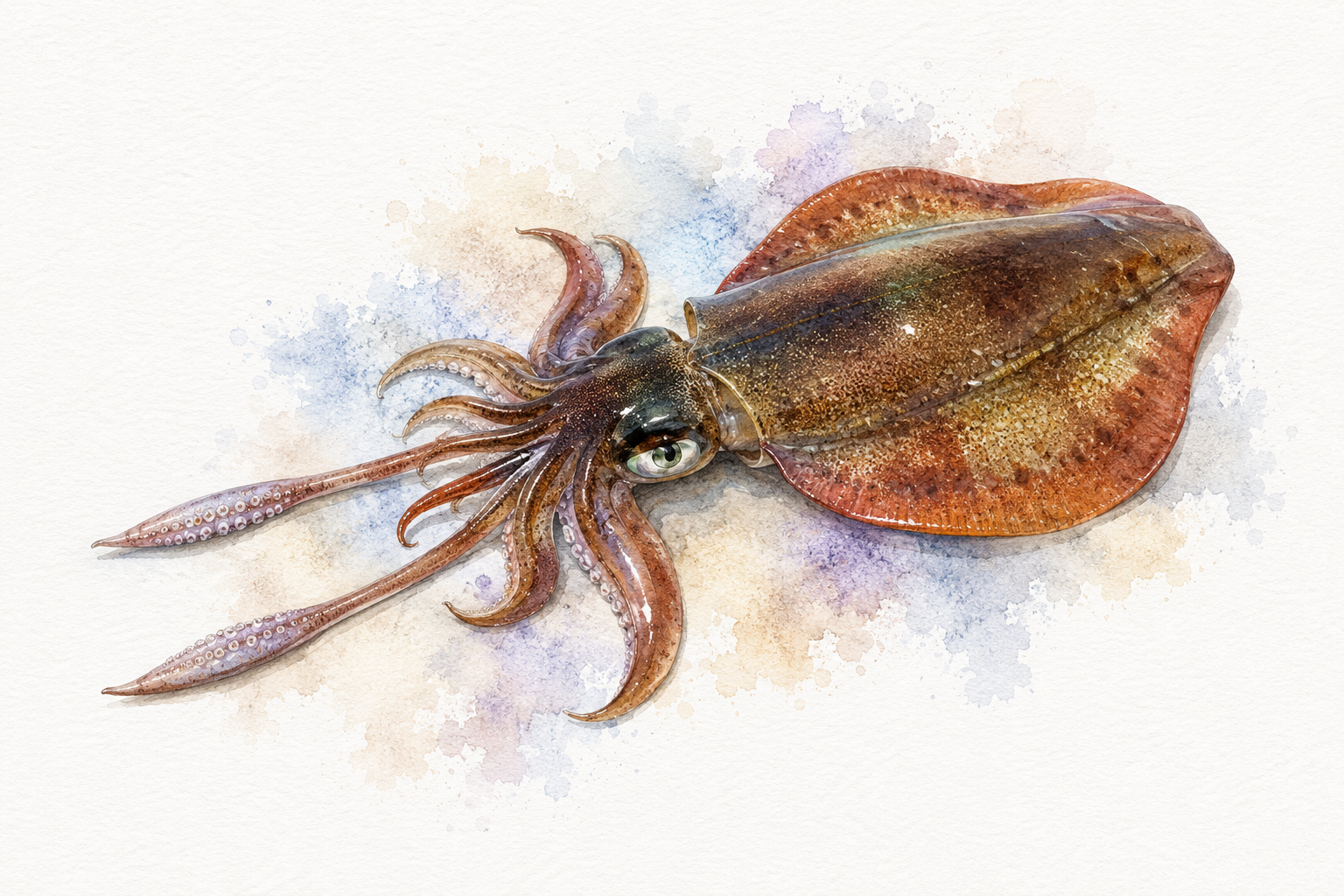
Seagrass beds provide feeding habitat for many squid species, including southern calamari.
Squid often patrol weed edges, sandy openings and areas where small fish and prawns concentrate.
Work the jig above the vegetation rather than dragging it through the weed.
A slower-sinking jig may provide better control in shallow water.
Allow enough descent to bring the lure into the intended strike zone, then use short lifts or darts followed by controlled pauses.
Rocky Shores and Headlands
Rocky shorelines and headlands can provide access to deeper water, reef edges and current lines.
Squid may hold around submerged rock, adjacent weed beds or nearby sandy areas.
A jig with sufficient casting distance and a suitable sink rate can be worked along these features.
Monitor the descent carefully, particularly where the bottom rises sharply or submerged rock creates snagging hazards.
Jetties, Wharves and Pontoons
Jetties, wharves and pontoons can provide access to squid feeding around artificial structure.
Lighting may attract baitfish and other prey, particularly after dark.
Squid can be found along shadow lines, near pylons and around adjacent weed or reef.
Allow the jig to descend to the intended depth before beginning the retrieve.
Where space permits, work the lure parallel to the structure rather than retrieving it immediately away from the area.
Coastal Reefs
Coastal reefs provide structure and feeding areas for squid.
Jigs can be worked along reef edges, over weed-covered ground and through nearby open water.
Depth control is important where reef rises close to the surface.
A jig that is suitable for deeper water may require shorter pauses when worked over shallow sections.
Offshore Waters
Squid can also be targeted from boats in deeper coastal waters.
Vertical presentations and controlled lift-and-drop techniques are useful when squid are holding beneath the boat.
Jig weight and sink rate must account for water depth, current and line angle.
In stronger current, maintaining a near-vertical presentation may require a different jig or a suitable weighted rig.
Tackle and Rigging
Rod Selection
Dedicated egi rods are designed to cast squid jigs and produce controlled darting movements.
They typically combine a responsive blank with sufficient flexibility to maintain pressure on squid during the fight.
Rod selection should suit the intended jig sizes and fishing location.
A rod that is too stiff may make controlled presentations difficult and increase the likelihood of pulling crowns free.
A rod that is too soft for the jig may struggle to produce effective darts.
Reel and Main Line
Light spinning reels are commonly used for squid fishing.
Braided line provides direct contact and helps transmit rod movements to the jig.
Its low stretch also makes it easier to detect changes in line tension during the descent.
Line selection should suit the jig weight, fishing environment and expected squid size.
Leader and Connections
Fluorocarbon or monofilament leaders are commonly used with squid jigs.
Leader strength should suit the fishing environment and abrasion risk.
Use a suitable connection that allows the jig to move freely.
Small clips can make jig changes convenient, provided they do not interfere with the lure’s balance or action.
Crown Inspection
Before fishing, inspect the crowns for bent, broken or corroded points.
Check that the crown assembly remains securely attached to the jig.
Avoid attempting to straighten severely damaged points repeatedly, as weakened metal may fail.
Replace damaged components where practical or retire the jig if the crown cannot be restored reliably.
Squid Jig Retrieve Techniques
Squid jigs are commonly worked using short movements followed by controlled descents.
The pause is an important part of the presentation because squid frequently approach or attack as the jig slows or sinks.
Twitch-and-Pause
This technique uses short rod movements to animate the jig without moving it excessively far from the intended area.
- Cast beyond the target.
- Allow the jig to descend towards the intended depth.
- Apply one or two short rod twitches.
- Recover excess line.
- Pause and allow the jig to descend again.
- Repeat while monitoring the line.
Twitch-and-pause can be effective around weed edges, shallow structure and areas where squid are responding to restrained movements.
Lift-and-Drop
Lift-and-drop presentations use a controlled upward movement followed by a descent.
- Cast and allow the jig to reach the intended depth.
- Raise the rod smoothly to lift the jig.
- Lower the rod while recovering unnecessary slack.
- Allow the jig to descend under control.
- Repeat as the lure moves through the target area.
The height of each lift determines how far the jig moves through the water column.
Shorter lifts are useful when fishing above shallow weed or reef.
Longer lifts may be suitable in deeper water.
Vertical Jigging
Vertical jigging is useful when fishing from boats, jetties or other locations where squid can be targeted beneath the angler.
- Lower the jig to the intended depth.
- Lift the rod to move the jig upward.
- Allow the jig to descend while maintaining controlled line contact.
- Repeat at a pace suited to the jig and squid behaviour.
Vertical jigging allows the lure to remain within a relatively confined area.
The presentation becomes more difficult when current creates a large line angle.
Egi Darting
Egi darting uses sharper, more deliberate rod movements to make a suitable jig change direction rapidly.
- Cast and allow the jig to descend.
- Apply a sharp upward or angled rod movement.
- Recover slack as the jig changes direction.
- Repeat with one or more controlled darts.
- Pause and allow the jig to sink naturally.
The objective is to produce distinct directional changes rather than simply lifting the jig repeatedly.
Not every squid jig is designed to dart aggressively.
Use this technique with models that respond appropriately to sharper rod movements.
Managing the Fall and Line Control
The descent is one of the most important stages of squid jig fishing.
After casting, allow the jig to sink towards the intended depth while monitoring the line.
A controlled, semi-slack line allows the jig to descend without being pulled unnaturally towards the angler.
Excessive tension can alter its sinking angle and movement.
Too much slack makes it difficult to detect contact or determine whether the jig has reached the bottom.
Counting Down the Jig
A countdown can help reproduce a working depth once squid are located.
Begin counting when the jig enters the water and use the same approximate count on subsequent casts.
This is a relative depth-control technique, not a precise measurement.
Wind, current, line angle and changes in the jig’s movement affect its descent.
If the jig contacts weed or bottom structure, shorten the count or select a slower-sinking model.
Detecting Squid During the Fall
Squid may grab the jig while it is sinking.
This can produce a sudden stop, sideways movement or unexpected change in line tension.
Sometimes the only indication is that the jig fails to descend as expected.
Recover slack and lift the rod smoothly to establish contact.
Avoid aggressive hook-setting movements, which can pull the crowns free.
Detecting Strikes and Landing Squid
A squid strike may feel like a sudden increase in weight, a soft pull or a change in the jig’s movement.
Once contact is established, maintain steady pressure.
Squid are held by the crown points rather than conventional hooks, and excessive force can tear the arms or tentacles.
Avoid repeated sharp rod movements once a squid is attached.
Retrieve smoothly and maintain tension as the squid approaches.
A landing net is useful, particularly for larger squid or when fishing from elevated structures.
When lifting a squid from the water, account for the possibility of the crowns pulling free under its weight.
Common Mistakes
| Mistake | Why It Matters | Better Approach |
|---|---|---|
| Selecting jig size without considering sink rate | May place the jig at the wrong depth | Choose size and sink rate together |
| Allowing the jig to sink uncontrollably | Increases snagging and reduces strike detection | Monitor the line during descent |
| Assuming nominal jig size indicates weight | Different models vary in construction | Check actual specifications |
| Working every jig with aggressive darts | Some models perform better with restrained movements | Match the retrieve to the jig’s design |
| Maintaining excessive line tension during pauses | Can alter the jig’s descent | Use controlled, semi-slack line |
| Allowing excessive slack | Makes strikes difficult to detect | Recover unnecessary slack promptly |
| Using long pauses over shallow weed | Increases snagging | Shorten the countdown or use a slower-sinking jig |
| Striking aggressively when squid take the jig | Can pull the crowns free | Lift smoothly and maintain pressure |
| Using damaged crowns | May reduce retention | Inspect and replace damaged components |
| Treating UV and glow as identical | They function differently | Select finishes according to their actual properties |
Care, Maintenance and Storage
Cleaning: Rinse squid jigs with fresh water after saltwater use, paying particular attention to the crowns and metal components.
Drying: Allow jigs to dry thoroughly before storage. Moisture trapped in cloth coverings or around metal components can encourage deterioration.
Crown Inspection: Check for bent, broken or corroded points. Replace damaged crowns where practical.
Cloth and Body: Inspect the outer covering for tears, loose sections and excessive wear. Damage may affect the jig’s appearance and durability.
Weight and Balance: Check that the weight and attachment points remain secure. Damage to these components can alter the jig’s descent.
Storage: Use dedicated jig cases or compartments that protect the crowns and prevent them from tangling with other tackle.
Heat and Sunlight: Avoid prolonged exposure to excessive heat and direct sunlight during storage, which can deteriorate coverings, adhesives and finishes.
The Bottom Line
Squid jigs are specialised lures designed to attract squid through controlled sinking, directional movements and pauses.
Choosing the appropriate size and sink rate is essential for keeping the jig within the intended strike zone, particularly around shallow weed beds, reefs and deeper coastal structure.
Twitch-and-pause, lift-and-drop, vertical jigging and egi darting each provide different ways to control the lure’s movement.
Successful squid jig fishing depends on understanding how the chosen jig sinks, maintaining suitable line contact and recognising strikes that occur during the descent.