
Introduction
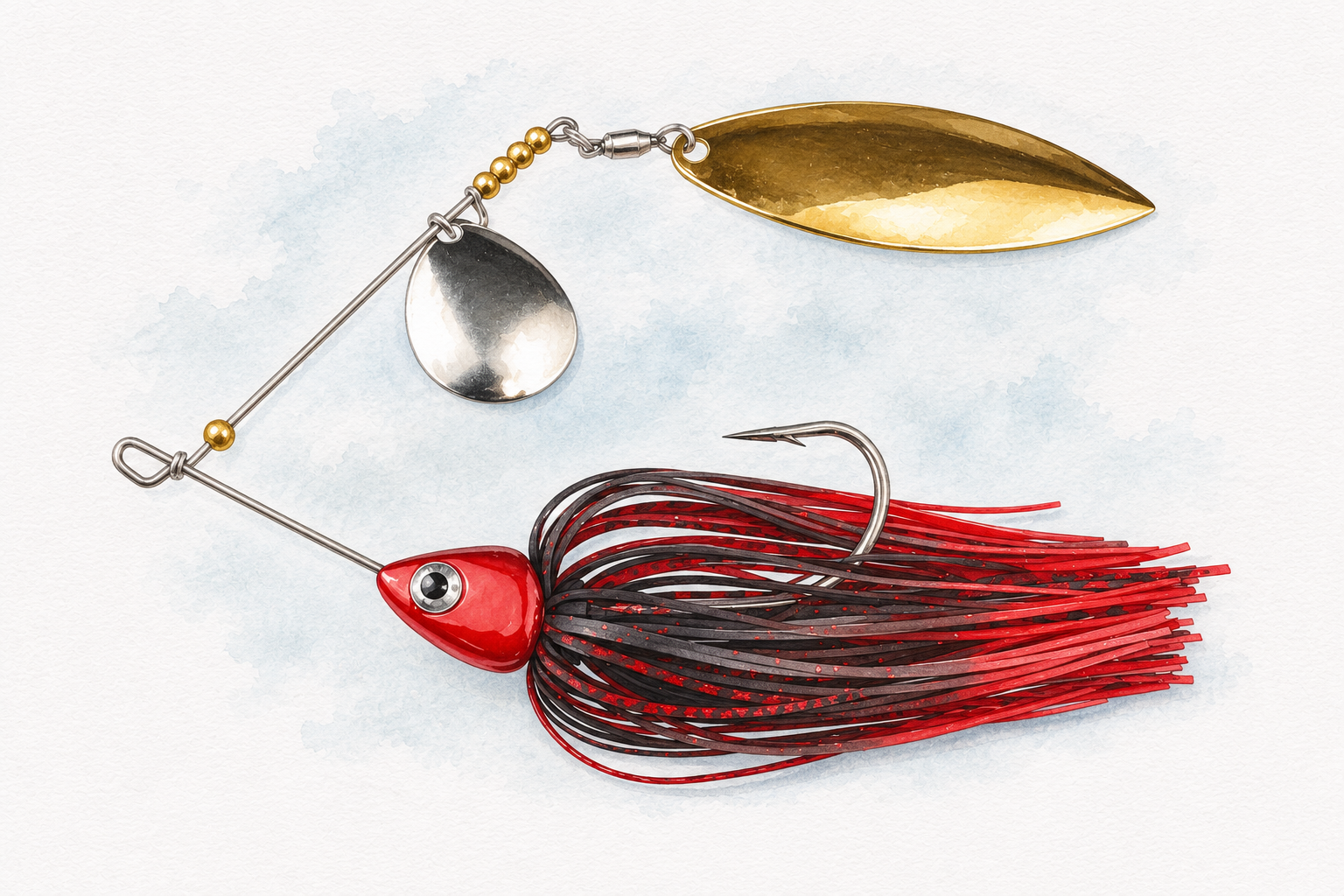
Spinnerbaits are wire-framed fishing lures designed to attract predatory fish through a combination of vibration, flash and movement.
Unlike conventional hard-bodied lures, spinnerbaits typically consist of a bent wire frame with one or more rotating metal blades mounted above a weighted head, skirt and single hook.
As the lure moves through the water, its blades rotate, producing vibration and reflected light. The skirt adds movement and bulk, while the weighted head helps control the lure’s swimming depth and attitude.
Spinnerbaits are particularly effective in Australian freshwater environments, where species such as Murray cod, golden perch and Australian bass frequently hold around submerged timber, rocky structure, weed beds and drop-offs.
Their wire-frame construction allows them to pass through many forms of structure with fewer snags than exposed multi-hook lures, although they are not completely snag-proof.
Successful spinnerbait fishing depends on selecting the appropriate blade configuration, weight and retrieve speed, then presenting the lure close to the areas where predatory fish are holding.
Understanding Spinnerbaits
Spinnerbaits produce their action through the interaction of rotating blades, water resistance, the wire frame and the weighted head.
Most conventional spinnerbaits have an upper wire arm supporting the blades and a lower arm carrying the weighted head, skirt and hook.
The upper arm helps deflect some obstacles away from the hook, while the lower section provides the lure’s main body profile.
Unlike inline spinners, where the blade rotates around the central shaft, spinnerbait blades rotate on hardware attached to a separate wire arm.
Wire Frame
The wire frame connects the blade assembly to the weighted head and hook.
Frame length, wire diameter and flexibility influence the lure’s vibration, durability and ability to move through structure.
A more flexible frame may transmit pronounced blade vibration, while a heavier frame can provide additional strength for large freshwater predators.
The frame must retain sufficient alignment for the blades to rotate freely.
Weighted Head
The weighted head controls much of the spinnerbait’s casting performance, sinking behaviour and working depth.
Head shape can also influence how the lure tracks through water and moves around obstacles.
Heavier spinnerbaits are useful when additional depth, casting distance or control in current is required.
Lighter models can be worked more slowly in shallow water without sinking as rapidly.
Skirt and Hook
Most spinnerbaits use a silicone or rubber skirt surrounding a fixed single hook.
The skirt moves and pulses as the lure travels through the water, creating a larger profile around the weighted head.
Some spinnerbaits also accept soft plastic trailers, which can add bulk, swimming action or resistance.
The hook must be sufficiently strong and appropriately sized for the intended target.
Spinnerbait Blade Types
Blade shape is one of the most important differences between spinnerbait designs.
It influences vibration, flash, water resistance and the speed at which the blades begin rotating.
Colorado Blades
Colorado blades are broad and rounded, producing relatively strong water displacement and pronounced vibration.
They are useful for slow retrieves, particularly when fish are holding around structure or visibility is limited.
Their higher water resistance also creates lift, which can help a spinnerbait remain higher in the water column at a given retrieve speed.
However, the additional resistance can make it more difficult to maintain depth in some conditions.
Willow Blades
Willow blades are longer and narrower, producing a tighter rotation and more concentrated flashes of reflected light.
They generally create less resistance than Colorado blades of comparable size.
This makes them useful for faster retrieves or presentations where the angler wants to maintain depth with less blade lift.
Willow blades are often selected when a baitfish-like flash is desirable.
Indiana Blades
Indiana blades have a shape between Colorado and willow blades.
They provide a compromise between vibration, flash and water resistance.
This makes them a versatile option when the angler wants more vibration than a narrow willow blade without the resistance of a broad Colorado blade.
Single and Tandem Blade Configurations
Spinnerbaits may use one blade or multiple blades.
A single large blade can provide a relatively simple, pronounced vibration pattern.
Tandem configurations combine blades of different sizes or shapes to alter flash, vibration and water resistance.
For example, a smaller Colorado blade may be paired with a larger willow blade.
The combined action depends on blade dimensions, spacing and the lure’s overall construction.
More blades do not automatically produce a more effective spinnerbait. The configuration must suit the intended retrieve and conditions.
Choosing the Right Spinnerbait
Weight and Working Depth
Spinnerbait weight should be selected according to water depth, current, retrieve speed and surrounding structure.
A lighter spinnerbait is useful for shallow presentations where a slow descent is desirable.
Heavier models can be worked deeper or used where current makes lighter lures difficult to control.
Blade resistance also affects working depth.
A spinnerbait with broad Colorado blades may rise more readily during retrieval than a similarly weighted model with narrower willow blades.
Choose the complete lure configuration rather than relying on head weight alone.
Blade Selection
Colorado blades are a useful starting point when slow retrieves and pronounced vibration are required.
Willow blades suit presentations where flash, reduced resistance or faster retrieval is desirable.
Indiana blades provide an intermediate option.
Water clarity can influence the decision, but blade choice should also reflect depth, current and the intended retrieve speed.
Skirt Colour and Profile
Spinnerbait skirts are available in natural, contrasting and highly visible colours.
White, silver and translucent combinations can resemble baitfish, while darker skirts create a defined silhouette.
Chartreuse and other contrasting colours may improve visibility in discoloured water.
Skirt bulk also influences the lure’s appearance and water resistance.
Choose a skirt that suits the intended presentation without interfering with the hook or blades.
Soft Plastic Trailers
Soft plastic trailers can be fitted to some spinnerbaits to increase body profile or add movement.
Paddle tails, curly tails and other suitable soft plastics may be used, depending on the lure’s design.
A trailer can change the spinnerbait’s balance, resistance and working depth.
An oversized or poorly aligned trailer may cause the lure to roll or track incorrectly.
Test the complete rig before fishing it around structure.
Where to Use Spinnerbaits
Submerged Timber
Submerged timber is one of the most productive environments for spinnerbait fishing.
Murray cod, golden perch and Australian bass frequently use timber as cover or as a feeding position.
Cast beyond or alongside the structure and retrieve the spinnerbait close enough to enter the fish’s strike zone.
The upper wire arm can help deflect some branches away from the hook.
However, spinnerbaits can still snag, particularly when the blade assembly or hook becomes caught between branches.
Control the retrieve and avoid unnecessarily forcing the lure through tight timber.
Rocky Banks and Drop-Offs
Spinnerbaits can be worked along rocky shorelines, submerged ledges and changes in bottom depth.
A slow retrieve can keep the lure close to the structure, while lift-and-drop presentations allow it to move vertically along a drop-off.
Monitor the line and lure resistance to distinguish blade vibration from contact with the bottom.
Weed Beds and Vegetation
Spinnerbaits can be effective around weed edges, openings and submerged vegetation.
Their wire-frame design helps them pass through some forms of vegetation, although fine or dense weed can wrap around the blades and prevent rotation.
Retrieve along the edge of the weed or through suitable openings.
If the blades stop rotating, recover the lure and remove accumulated vegetation.
Rivers and Creeks
In rivers and creeks, spinnerbaits can be presented around timber, undercut banks, rocky structure and current breaks.
Current affects both the lure’s working depth and blade rotation.
Retrieving with or against the current can produce different lure speeds relative to the surrounding water.
Adjust winding speed to maintain blade rotation without pulling the lure away from the intended depth.
Lakes and Impoundments
Spinnerbaits are useful for searching banks, submerged timber, weed beds and drop-offs in lakes and impoundments.
They can cover water efficiently while remaining suitable for slower presentations around individual pieces of structure.
Where fish are holding deeper, select a suitable weight and blade configuration to maintain the intended working depth.
Tackle and Rigging
Rod Selection
Spinnerbait rods must provide sufficient casting performance, lure control and hook-setting power.
Medium-heavy to heavy baitcasting outfits are commonly used for larger freshwater spinnerbaits, particularly when targeting Murray cod around structure.
Lighter outfits can be suitable for smaller spinnerbaits used for Australian bass and golden perch.
Rod selection should reflect lure weight, hook size, target species and the amount of control required near structure.
Reel and Main Line
Baitcasting reels are widely used for spinnerbait fishing because they provide controlled casting and direct lure contact.
Spinning outfits can also be suitable, particularly for smaller spinnerbaits.
Braided line provides direct feedback from the blades and helps detect changes in resistance.
Line strength and reel drag should suit the intended target and fishing environment.
Leader Selection
Leader strength should account for abrasion around timber, rocks and other structure.
A suitable monofilament or fluorocarbon leader can provide abrasion resistance and a connection between the main line and spinnerbait.
Avoid unnecessarily bulky hardware that interferes with the lure’s alignment.
Line Attachment
Many spinnerbaits use an R-shaped bend in the wire frame as the line attachment point.
This design works well with a direct knot, but some clips or snaps can slide along the open bend during casting or retrieval.
Spinnerbaits with a closed line-tie eye are generally better suited to snap connections.
If using a clip with an open R-bend, use a suitable retaining arrangement designed to prevent the clip from moving out of position.
Trailer Hooks
Some spinnerbaits can accommodate a trailer hook behind the main hook.
A trailer hook may improve hook contact when fish strike short, but it also increases the likelihood of snagging.
It can reduce the spinnerbait’s ability to pass through timber and vegetation.
Use trailer hooks only where the fishing environment and lure design make them appropriate.
Spinnerbait Retrieve Techniques
Spinnerbaits produce much of their action automatically as their blades rotate.
The angler’s main tasks are controlling retrieve speed, maintaining the intended depth and presenting the lure close to fish-holding structure.
Steady Retrieve
A steady retrieve keeps the spinnerbait swimming at a relatively consistent speed and depth.
- Cast beyond the intended target.
- Allow the lure to descend towards the required depth.
- Begin retrieving at a speed that maintains blade rotation.
- Adjust rod angle and winding speed to keep the lure within the intended strike zone.
This technique is useful for covering water and searching banks, weed edges and submerged structure.
Slow Roll
Slow rolling involves retrieving the spinnerbait at a low speed while maintaining blade rotation.
- Cast beyond the intended structure.
- Allow the lure to descend to the required depth.
- Retrieve slowly enough to keep it near the target.
- Maintain contact and monitor the blade vibration.
- Adjust speed if the blades stop rotating.
Slow rolling is particularly effective around submerged timber, rocky structure and deeper edges.
Blade selection is important because some configurations begin rotating more readily at low speeds than others.
Stop-and-Go
Stop-and-go retrieves alternate between swimming and brief pauses.
- Retrieve the spinnerbait through the intended area.
- Stop winding briefly.
- Allow the lure to descend.
- Resume retrieving to restart the blades.
The change in speed and depth can trigger fish following the lure.
Blade rotation usually slows or stops during the pause, depending on the lure’s design and movement.
Avoid long uncontrolled descents around snag-prone structure.
Lift-and-Drop
Lift-and-drop presentations allow the spinnerbait to move vertically through part of the water column.
- Cast and allow the lure to reach the intended depth.
- Lift the rod to move the spinnerbait upward.
- Lower the rod while recovering excess slack.
- Allow the lure to descend under control.
- Repeat along the intended area.
Some blades continue rotating during part of the descent, while others stop.
The action depends on blade configuration, line tension and the lure’s orientation.
This technique can be useful around drop-offs and deeper structure.
Burning / High-Speed Retrieve
Burning involves retrieving the spinnerbait rapidly while maintaining blade rotation and a stable swimming attitude.
- Cast beyond the target area.
- Begin retrieving at a moderate speed.
- Increase speed while monitoring the lure.
- Reduce speed if it rolls, breaks the surface unintentionally or loses stability.
High-speed retrieves can be effective when predators are actively chasing prey.
Not all spinnerbaits remain stable at high speeds.
Blade resistance, head weight and frame alignment influence their suitability.
Detecting Strikes and Hook-Setting
Spinnerbait strikes may feel like a sharp impact, sudden increase in weight or interruption to the normal blade vibration.
Because the blades produce continuous resistance, a change in that resistance can indicate contact with a fish or surrounding structure.
When a fish takes the lure, recover unnecessary slack and apply firm pressure to drive the single hook home.
The force required depends on hook size, tackle and the target species.
Avoid allowing the fish unnecessary slack, particularly when fishing around submerged timber.
Maintain steady pressure and control the fish’s movement away from nearby obstacles where the tackle allows.
Common Mistakes
| Mistake | Why It Matters | Better Approach |
|---|---|---|
| Choosing spinnerbait weight without considering blade resistance | Broad blades can increase lift and alter working depth | Match weight and blade configuration to the intended presentation |
| Retrieving too slowly for blade rotation | Reduces vibration and flash | Maintain the minimum speed required for reliable rotation |
| Retrieving too quickly for the lure’s balance | Can cause rolling or instability | Reduce speed or select a more suitable design |
| Assuming spinnerbaits are snag-proof | Blades and hooks can still catch on timber and vegetation | Control the retrieve around obstacles |
| Using unsuitable clips on an open R-bend | Clips may move along the wire frame | Use a direct knot or suitable retaining arrangement |
| Adding an oversized soft plastic trailer | Can interfere with balance and swimming action | Match trailer size to the spinnerbait |
| Ignoring wire-frame damage | Misalignment can affect blade rotation and tracking | Inspect and correct minor distortion or replace damaged frames |
| Using trailer hooks in dense timber | Increases snagging | Reserve trailer hooks for suitable open-water applications |
| Selecting blade type solely by water clarity | Ignores depth, resistance and retrieve speed | Consider the complete presentation |
| Allowing uncontrolled slack during pauses | Makes strikes harder to detect and increases snagging | Monitor the line and control the descent |
Care, Maintenance and Storage
Cleaning: Rinse spinnerbaits with fresh water after use, particularly when exposed to salt or dirty water.
Blades: Inspect blades for bending, corrosion and damage. Confirm they rotate freely without contacting the wire frame or skirt.
Swivels and Hardware: Check swivels, clevises, split rings and other components for wear or restricted movement.
Wire Frame: Inspect for cracks, severe bends or fatigue, particularly around the line-tie bend and head connection. Repeated bending can weaken the wire.
Hooks: Check hook points, shanks and attachment areas for damage or corrosion. Replace compromised components where practical.
Skirts: Inspect silicone or rubber strands for tearing, sticking or deterioration. Replace damaged skirts or retaining bands.
Trailers: Remove soft plastic trailers when necessary to prevent deformation or material reactions during storage.
Storage: Keep spinnerbaits in suitable compartments or dedicated storage systems that minimise frame distortion and blade tangling.
The Bottom Line
Spinnerbaits are versatile freshwater lures that combine rotating blades, a weighted head and a skirted hook to produce vibration, flash and movement.
Their wire-frame construction makes them particularly useful around submerged timber, weed edges and other structure where predatory fish frequently hold.
Blade selection influences vibration, water resistance and working depth, while head weight and retrieve speed determine how the lure moves through the water.
The most effective spinnerbait presentation is one that maintains reliable blade rotation while keeping the lure close to the intended strike zone.
Understanding blade configuration, controlling retrieve speed and maintaining the lure’s alignment are central to successful spinnerbait fishing.