

TACKLE AND RIGS
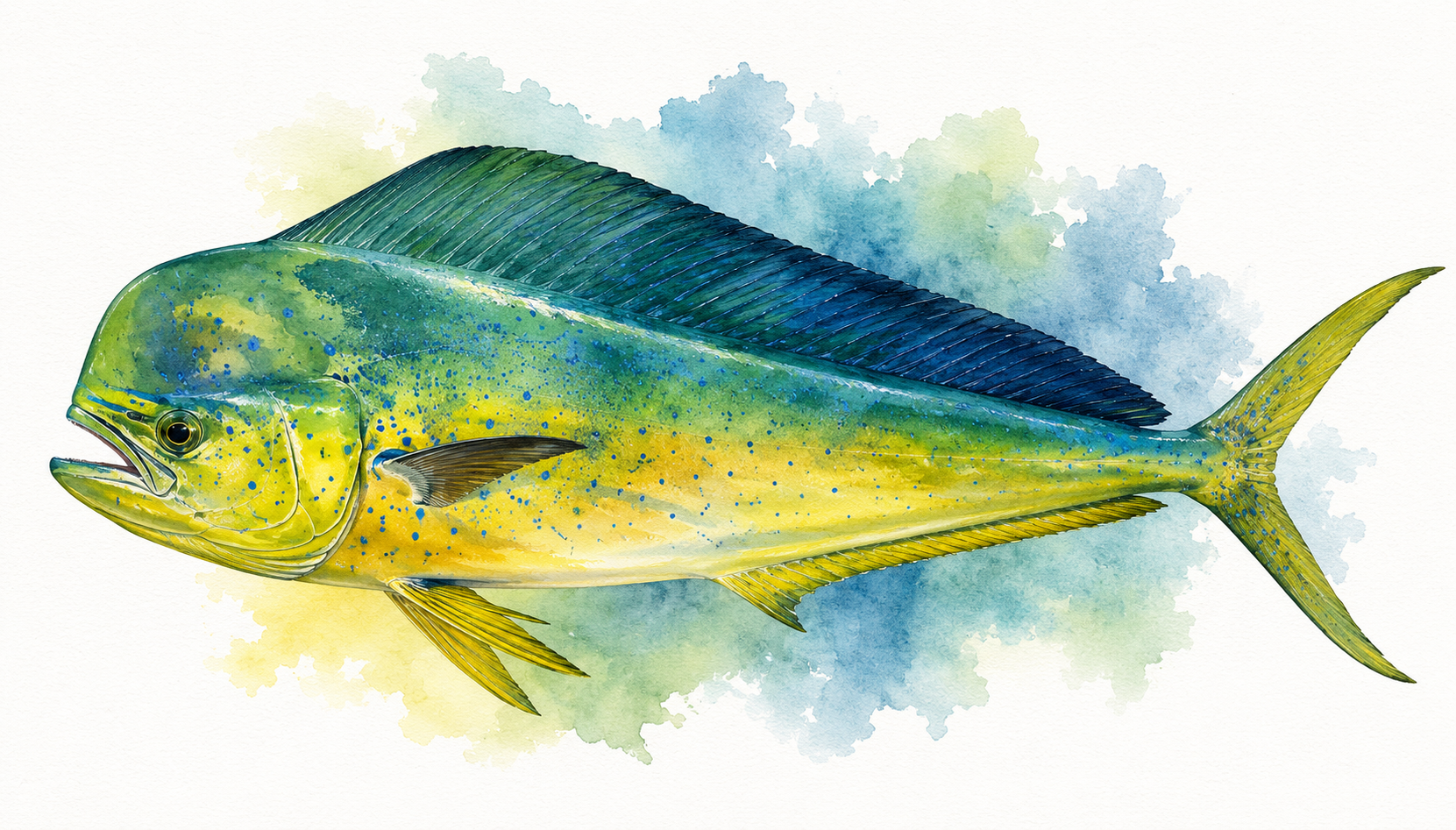
Dolphinfish are among the most exciting sportfish available to Australian offshore anglers. Their speed, aerial displays and relentless direction changes make them formidable opponents on appropriately balanced tackle. Unlike species that rely primarily on brute force, mahi mahi fight with pace, athleticism and unpredictability, often producing spectacular jumps throughout the battle.
For most Australian conditions, rods between 6 and 8 feet rated for 10–24kg line classes provide an ideal combination of casting performance, lifting power and fish-fighting control. Reels in the 5000–10000 size range matched with 20–50lb braid offer more than enough capability for the majority of fish encountered around FADs, weed lines and floating structure.
Leaders between 40–80lb fluorocarbon provide abrasion resistance while maintaining presentation quality. Terminal tackle should be strong and reliable, with circle hooks and quality live-bait hooks accounting for the majority of successful captures. Heavy-duty swivels are commonly used, while wire traces are rarely necessary.
Popular rig options include unweighted live-bait rigs, slow-trolled live baits, pilchard drift rigs and surface skip-bait presentations. While heavy tackle certainly has a place when exceptionally large fish are expected, many anglers find lighter outfits provide a far more enjoyable sporting experience.
WHEN TO USE LURES
Dolphinfish are one of Australia’s most lure-responsive gamefish and frequently attack artificial presentations with little hesitation.
Lures are particularly effective when searching large areas of offshore water, investigating FADs and weed lines, targeting surface-feeding fish or working active bait schools. Their aggressive feeding behaviour makes them ideal candidates for both casting and trolling techniques.
Small skirted trolling lures, stickbaits, surface poppers, metal slugs, soft plastics and diving minnows all produce excellent results when matched to prevailing baitfish.
Fast, erratic retrieves often trigger aggressive reaction strikes, while surface disturbance and sudden directional changes can provoke spectacular visual attacks. High-speed trolling presentations are also highly effective when covering water and locating active fish.
Because mahi mahi are strongly visual predators, many strikes occur within sight of the boat, adding to their appeal as a premier sportfishing species.
TIME OF DAY
Dawn and early morning periods often produce the most consistent fishing, particularly when offshore bait activity coincides with favourable current movement.
Unlike many pelagic species, dolphinfish commonly remain active throughout the day and frequently feed aggressively under bright sunlight. Productive fishing can occur whenever active fish are present around floating structure, current lines or bait concentrations.
Overcast conditions often extend feeding activity and may create productive bite windows throughout the day.
Rather than focusing solely on the clock, successful anglers place greater emphasis on water quality, bait presence and floating structure.
COMMON MISTAKES
One of the most common mistakes made by offshore anglers is failing to inspect floating objects thoroughly. Weed lines, buoys, logs and other debris often appear insignificant at first glance but may hold substantial numbers of fish.
Many anglers also troll too far from FADs and fail to properly investigate the surrounding structure. Similarly, leaving an area immediately after landing a fish can result in missed opportunities, as entire schools frequently remain beneath the boat.
Fishing cold or dirty water significantly reduces the likelihood of encountering mahi mahi, while excessively heavy tackle often reduces the sporting qualities that make the species so popular.
Another common oversight is failing to carry live bait. While lures are highly effective, live bait can prove invaluable when fish become cautious or remain tightly associated with structure.
THE BOTTOM LINE
Successful dolphinfish fishing is built around four simple ingredients: warm blue water, current, floating structure and bait.
Whenever these elements come together, the chances of encountering mahi mahi increase dramatically. Every FAD, buoy, weed line and floating log should be treated as a potential hotspot and investigated thoroughly.
Consistent anglers cover water efficiently, remain observant and pay close attention to signs of life around offshore structure. When conditions align, few Australian gamefish offer a combination of accessibility, aggression and spectacle equal to that of the dolphinfish.