
Introduction
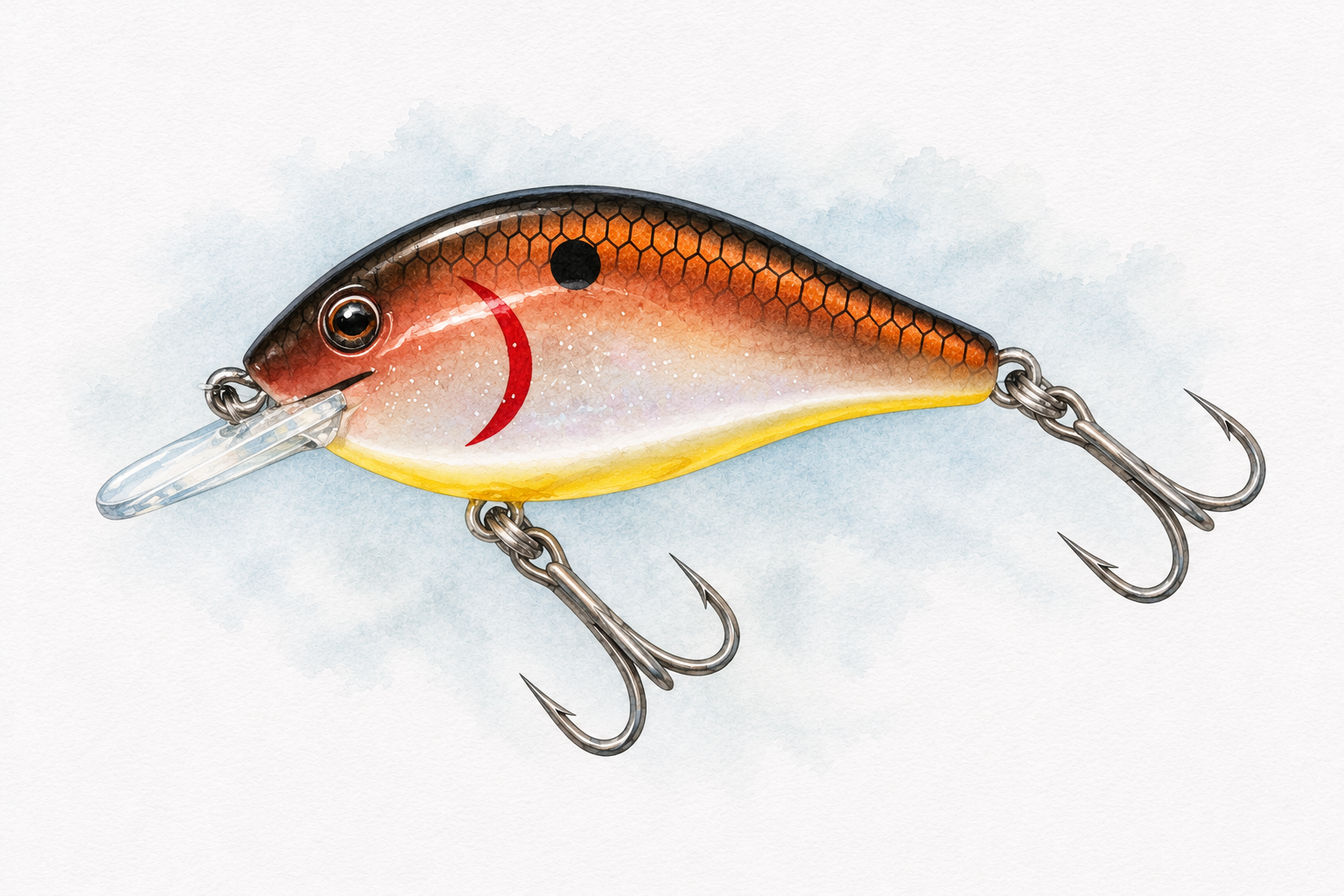
Crankbaits are compact hardbody lures designed to produce a pronounced swimming action during retrieval. Most have relatively short, deep bodies and a projecting bib that causes the lure to dive and wobble as it moves through the water.
Unlike slender diving minnows, crankbaits are commonly designed to generate their action through a steady retrieve rather than repeated rod movements. Their wobbling and rolling movements imitate small baitfish, while specialised designs may resemble crabs or aquatic insects.
Crankbaits are particularly useful for covering water, following submerged contours and working around structure. Their bibs can also help deflect the hooks away from obstacles when the lure makes controlled contact with timber, rock or the bottom.
In Australian waters, crankbaits are used for species including Australian bass, golden perch, Murray cod, barramundi, mangrove jack, flathead and bream.
Understanding Crankbaits
Body Shape and Swimming Action
Most crankbaits have compact, rounded or deep-bodied profiles.
Their shape produces a distinctive wobbling or rolling action as water flows around the body and bib.
Some models swim with a tight, rapid vibration, while others produce a wider side-to-side movement.
Tight-action crankbaits can be useful when fish respond to a more restrained presentation. Wider-wobbling models produce stronger movement and may help attract attention when covering water.
The swimming action is built into the lure’s design, so crankbaits generally require less rod movement than diving minnows.
Bib Design
The bib controls much of a crankbait’s diving behaviour and swimming action.
Short, steeply angled bibs are common on shallow-running models. Longer, more forward-projecting bibs are often used on deeper-diving designs.
The bib also acts as the lure’s first point of contact with many underwater obstacles.
When a crankbait contacts rock or timber, the bib may deflect the body and hooks away from the obstruction.
This does not make crankbaits snag-proof, particularly around branches, weed and irregular rock.
Internal Weighting and Rattles
Crankbaits may contain fixed weights, moving weights or internal rattles.
Weight placement affects casting performance, balance and swimming action.
Rattling models produce sound as they move, providing an additional stimulus in discoloured water.
Silent crankbaits offer a less conspicuous presentation in clear water or heavily fished areas.
Types of Crankbaits
Shallow-Diving Crankbaits
Shallow-diving crankbaits operate close to the surface and are useful around shallow timber, weed beds, rocky margins and submerged vegetation.
Many floating models can be paused to rise away from obstacles.
They are popular for Australian bass, bream and other predators feeding in shallow water.
Medium-Diving Crankbaits
Medium-diving crankbaits are suited to channel edges, submerged timber, rocky banks and moderate-depth structure.
They provide a balance between diving ability and the capacity to work through relatively shallow areas.
Choose a model that reaches the intended strike zone without continually digging into the bottom.
Deep-Diving Crankbaits
Deep-diving crankbaits use bib designs that allow them to reach greater depths during retrieval.
They are particularly useful for fishing submerged points, deeper timber, rock ledges and bottom contours.
Deep-diving models are established freshwater options for golden perch and Murray cod.
They can also be used around deeper estuary structure where suitable.
A deep-diving crankbait needs sufficient retrieval distance to reach its intended depth, making casting position important.
Square-Bill Crankbaits
Square-bill crankbaits have broad, squared-off bibs designed to help the lure deflect around certain obstacles.
They are particularly useful around timber, rocks and other relatively hard structure.
Their compact bodies and pronounced swimming action make them effective when worked close to cover.
The square bib can reduce snagging during controlled contact, but the lure can still become caught in branches or crevices.
Lipless Crankbaits
Lipless crankbaits are compact hardbody lures without a projecting diving bib.
They generate vibration through their body shape and line-tie position, and many are designed to sink.
They can be retrieved steadily, allowed to sink to different depths or worked with lifts and pauses.
Although commonly grouped with crankbaits, their operating characteristics differ substantially from conventional bibbed designs. They are better treated as part of the separate vibration-lure family.
Floating, Suspending and Sinking Crankbaits
Floating Crankbaits
Floating crankbaits rise when retrieval stops.
They are useful around timber, rocks and shallow structure where allowing the lure to rise can help clear obstacles.
Floating models are particularly effective when worked with occasional pauses or controlled bottom contact.
Suspending Crankbaits
Suspending crankbaits remain near their working depth during pauses.
They allow anglers to interrupt the retrieve without immediately moving the lure away from fish holding near structure.
Their buoyancy can change with replacement hooks, split rings and water conditions.
Sinking Crankbaits
Sinking crankbaits descend when retrieval stops.
They can be allowed to sink before retrieval begins, making them useful when fish are holding below the reach of shallow-running floating models.
Control their descent around snag-prone structure.
Sinking designs are less common among traditional bibbed crankbaits than floating models, but they remain a legitimate variation.
Choosing the Right Crankbait
Size and Profile
Small crankbaits are useful for bream, bass and other predators feeding on small baitfish, insects or crustaceans.
Medium-sized models suit many estuary and freshwater applications, including flathead, golden perch and mangrove jack.
Larger crankbaits are used for barramundi and Murray cod.
Choose a size that suits the available prey and the conditions rather than automatically selecting the largest lure the fish can swallow.
Running Depth
Running depth is one of the most important crankbait characteristics.
Choose a lure that reaches the depth where fish are holding.
When fishing submerged rock or timber, a crankbait that occasionally contacts structure may trigger strikes through sudden changes in movement.
However, a lure that continually digs into the bottom or becomes trapped is running too deep for the conditions.
Advertised diving depths are approximate and depend on casting distance, line thickness, retrieve speed and lure design.
Swimming Action
Crankbaits vary from tight, rapid wobbling movements to broad, rolling actions.
A tight-action model provides a relatively restrained presentation.
A wider-wobbling crankbait creates stronger movement and may be useful when fish are actively feeding or when covering water.
If fish follow or strike short, try a different action or retrieve speed before changing lure colour.
Colour and Finish
Natural baitfish colours are useful in clear water and where fish are feeding on small bait.
Brown, olive and darker finishes can resemble crustaceans or provide a distinct silhouette.
Bright or contrasting colours may be useful in discoloured water.
Crankbaits that contact rock or timber will eventually develop scratches and worn finishes. Minor cosmetic damage does not necessarily affect their swimming action.
Rattling and Silent Designs
Rattling crankbaits provide an additional stimulus through sound and vibration.
Silent models are useful when a less conspicuous presentation is preferred.
Both are worth carrying when fishing areas with changing water clarity or fishing pressure.
Where to Use Crankbaits
Estuaries and Channels
Crankbaits are effective around rock walls, channel edges, submerged timber and other estuary structure.
Small models can be worked along oyster-covered rock walls for bream.
Medium-sized crankbaits can be retrieved along channel edges and drop-offs for flathead.
Around mangrove roots and submerged timber, choose a running depth that keeps the lure close to the structure without repeatedly becoming snagged.
Shallow Flats and Weed Beds
Shallow-running crankbaits can be used along weed edges, shallow flats and submerged vegetation.
Retrieve above the weed or along openings between vegetation.
Floating models can be paused to rise away from the weed before continuing.
Compact crankbaits can also imitate small prey moving across shallow sand or broken bottom.
Submerged Timber
Crankbaits are particularly useful around submerged timber because their bibs can help deflect the hooks away from obstacles.
Cast beyond the structure and retrieve towards the intended holding position.
Allow the bib to contact suitable timber occasionally, then continue the retrieve or pause briefly.
Avoid forcing the lure through dense branches where the hooks are likely to become trapped.
Rocky Banks and Drop-Offs
Retrieve crankbaits parallel to rocky banks, submerged ledges and changes in bottom depth.
Where the lure occasionally contacts rock, a brief interruption in its swimming action may attract attention.
If the lure repeatedly jams between rocks, change the retrieve angle or select a shallower-running model.
Coastal Reefs
Compact crankbaits can be used around sheltered coastal reef edges and shallow rocky structure where smaller predators feed.
Choose models with suitable casting weight, hooks and running depth for the conditions.
Avoid forcing deep-diving crankbaits through irregular reef where the bib and hooks can become trapped.
Rivers and Creeks
Crankbaits are useful around riverbanks, timber, rocky edges and deeper pools.
Australian bass, golden perch, Murray cod and Sooty Grunter can be targeted with suitable models.
Current affects how strongly the lure swims.
When retrieving against the current, reduce winding speed if the lure begins rolling or loses its intended action.
Casting across current can help work a crankbait along banks and submerged structure.
Lakes and Impoundments
Crankbaits are effective for covering submerged points, rocky banks, timber and changes in depth.
Medium and deep-diving models are useful for golden perch and Murray cod holding near submerged structure.
Cast beyond the intended target and retrieve through the strike zone.
Where the bottom depth changes, adjust lure selection or retrieve angle to maintain an effective presentation.
Tackle and Rigging
Rod Selection
A rod with a responsive, moderately forgiving action is useful for many crankbait applications.
It allows the lure to swim naturally and helps maintain pressure when fish strike.
Small crankbaits are best matched with lighter tackle, while larger models and powerful fish require stronger equipment.
Reel and Main Line
Spinning and baitcasting outfits are both suitable.
Spinning tackle works well with small crankbaits, while baitcasting outfits can provide accurate casting around timber and other structure.
Braided line offers direct contact and makes it easier to detect changes in the lure’s swimming action.
Line thickness can affect running depth, particularly with smaller or deeper-diving models.
Leader Selection
Use leader strength appropriate to the target species and surrounding structure.
Lighter leaders suit small crankbaits in relatively open water.
Heavier abrasion-resistant leaders are useful around rock, timber and reef.
Avoid unnecessarily stiff or oversized leader arrangements that interfere with small crankbaits.
Line Attachment
Use a connection that allows the crankbait to swim freely.
Depending on the lure, this may involve a split ring, loop knot or suitable clip.
Check that the attachment does not restrict movement or interfere with the bib.
Hook Configuration
Most conventional crankbaits are fitted with treble hooks, although suitable single-hook replacements can be used.
Replacement hooks should provide adequate strength without interfering with the lure’s swimming action.
Heavier hooks can affect buoyancy, particularly on suspending models.
Crankbait Retrieve Techniques
Steady Retrieve
A steady retrieve is the standard crankbait presentation.
- Cast beyond the intended target.
- Begin retrieving to bring the lure to its working depth.
- Maintain a speed that produces a consistent swimming action.
- Continue through the strike zone.
This technique is effective for covering water and searching for actively feeding fish.
Slow Roll
Slow rolling keeps the crankbait moving at a relatively low speed.
Retrieve just fast enough to maintain the lure’s intended swimming action.
This is useful around timber, rock walls and deeper structure where fish may respond to a slower presentation.
Stop-and-Go
Stop-and-go retrieves interrupt the lure’s swimming action.
Retrieve to the intended depth, pause briefly, then resume.
Floating crankbaits rise during pauses, while suspending and sinking models behave according to their buoyancy.
Vary pause duration when fish follow without striking.
Bottom Contact and Deflection
Crankbaits can be particularly effective when their bibs make controlled contact with suitable hard structure.
- Select a lure that reaches the bottom or obstacle.
- Retrieve until the bib makes contact.
- Allow the lure to deflect or briefly interrupt the retrieve.
- Continue winding once it clears the obstacle.
This technique is useful around rock, firm bottom and suitable timber.
Avoid repeatedly driving the lure into crevices, dense branches or other snag-prone structure.
Changing Retrieve Speed
A brief increase or decrease in retrieve speed can change the crankbait’s swimming rhythm.
This can be useful when fish follow without striking.
Keep speed changes controlled so the lure maintains its intended action.
Managing Depth and Structure Contact
Reaching the Intended Depth
Crankbaits need sufficient retrieval distance to reach their designed running depth.
Cast beyond the intended target so the lure is already swimming at the correct depth when it enters the strike zone.
For deeper-running models, longer casts may be necessary.
Following Bottom Contours
A crankbait that occasionally contacts the bottom can be useful when fish are holding close to rock or firm substrate.
However, changes in bottom depth can cause the lure to dig in or lose contact.
Adjust casting angle, retrieve speed or lure depth to suit the contour.
Avoiding Snags
The bib can help protect the hooks during some types of contact, but crankbaits are not snag-proof.
When a floating crankbait contacts an obstacle, briefly stopping the retrieve may allow it to rise clear.
Avoid pulling aggressively against a snag, which can drive the hooks deeper into the obstruction.
Lure Tuning and Tracking
Checking Swimming Action
A crankbait should swim consistently at its intended retrieve speed.
If it repeatedly veers to one side, rolls excessively or loses its normal wobble, check its tracking.
Test the lure in relatively still water before assuming it needs adjustment.
Tow-Point Adjustment
Some crankbaits have adjustable tow points.
Where the manufacturer permits tuning, make small adjustments and retest after each change.
Do not force rigid components or attempt to correct a damaged bib through tuning.
Damage and Water Ingress
Inspect the bib, tow point, body and hooks after significant impacts.
Cracks, loose components or water entering the body can alter balance and swimming action.
Replace damaged components where practical.
Detecting Strikes and Hook-Setting
Crankbait strikes often occur during steady retrieval, immediately after contacting structure or when the lure changes speed.
A strike may feel like a sharp impact, sudden weight or interruption to the normal wobbling action.
Maintain contact and apply controlled pressure rather than repeatedly striking aggressively with treble hooks.
Keep steady tension during the fight and guide fish away from nearby structure.
Common Mistakes
| Mistake | Why It Matters | Better Approach |
|---|---|---|
| Wrong running depth | Lure passes above fish or digs into obstacles | Match diving range to the strike zone |
| Retrieving too quickly | Some crankbaits lose their intended swimming action | Maintain a suitable retrieve speed |
| Avoiding all structure contact | Misses opportunities to trigger strikes | Allow controlled bib contact where appropriate |
| Forcing the lure into snags | Hooks become trapped in branches or crevices | Adjust depth, angle or retrieve |
| Using unsuitable hardware | Can alter action and buoyancy | Match hooks and leader to lure size |
| Poor casting position | Lure reaches working depth after passing the fish | Cast beyond the target |
| Ignoring tracking problems | Reduces swimming effectiveness | Check speed, current and hardware |
| Repeating an unsuccessful retrieve | Fish may follow without striking | Change speed, pauses or lure action |
Care, Maintenance and Storage
Cleaning: Rinse saltwater-exposed crankbaits with fresh water and allow them to dry.
Hooks and Split Rings: Inspect for corrosion, bending and wear. Replace damaged components.
Diving Bib: Check for cracks, chips and looseness, particularly after repeated contact with rock or timber.
Body and Finish: Inspect for cracks, damaged seams and water ingress.
Swimming Action: Test the lure after significant impacts, hardware changes or tuning.
Suspension: Recheck buoyancy after changing hooks or split rings.
Storage: Use divided tackle compartments or protective sleeves to prevent hook tangles and damage.
Moisture: Dry lures before storing them with clean tackle.
The Bottom Line
Crankbaits are compact hardbody lures designed to produce a pronounced swimming action during retrieval.
Their strength lies in covering water, working submerged structure and following bottom contours.
Choose a model with the appropriate running depth, swimming action and buoyancy for the conditions.
A controlled retrieve that keeps the lure working through the strike zone is usually more valuable than excessive rod movement.